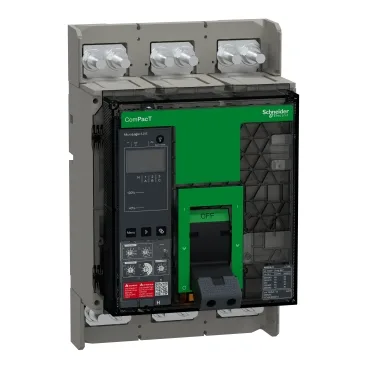
The C063H35EFM is a 3-pole ComPacT NS new generation moulded-case circuit breaker from Schneider Electric, rated 630 A at 50 °C and built to EN/IEC 60947-2 for distribution duty. It carries a MicroLogic 5.0 E electronic trip unit with L (long-time overload), S (short-time short-circuit), and I (instantaneous short-circuit) protection curves, plus an integrated energy meter. The electronic trip unit includes a 20-minute thermal memory, so the breaker remembers prior heating on reclose after a trip — useful on motor or transformer feeders where repeated close-in faults can overheat windings before the overload curve resets. Four red LEDs signal fault type (overload, short-circuit, earth-leakage absent here), and one yellow LED flags an active overload condition. The LCD display on the front face shows metered energy data and trip event logs.
Breaking capacity — what the H code means for selectivity
The H suffix in the order code maps to 70 kA Icu at 415 V AC, 85 kA at 240 V, and 42 kA at 690 V. For selectivity studies, the S (short-time) protection can be set with a delay up to 0.5 s, letting downstream breakers clear first. Category B utilisation means it's rated for selective coordination, not just cable protection. The fixed-mount, front-connection design (upside and downside both front) suits standard backplate mounting in switchboards. Connection pitch is 70 mm, and overall dimensions are 327 mm high, 210 mm wide, 147 mm deep. IP40 front face, IK07 impact resistance — adequate for enclosed distribution panels; not rated for washdown environments.
Deployment context
Mounts on a backplate inside a distribution switchboard or motor control centre. Front connections simplify busbar routing and cable entry. The 10 W power loss at rated current matters for enclosure thermal design — factor it into your ventilation or derating calculation if the panel runs multiple breakers at full load. Electrical durability is 2000 cycles at 690 V In, 6000 cycles at 440 V In/2; mechanical durability is 10000 cycles. That's typical for a distribution breaker — not designed for frequent switching duty like a contactor. Overvoltage category III covers fixed-installation distribution boards.