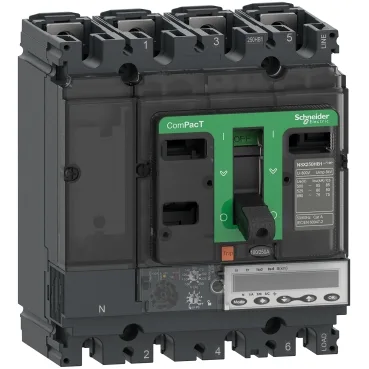
The trip unit gives you LSI+G protection — overload (long-time), short-time short-circuit, instantaneous short-circuit, and ground fault — all adjustable from the front LCD display. That's a serious interrupting rating for a 40 A frame — it lets you use this breaker downstream of a high-capacity transformer without worrying about cascading failure. At 690 V AC it still holds 75 kA Icu, which is rare for a compact frame. The 20-minute thermal memory before and after tripping is a detail that matters on motor circuits or feeders with repetitive overloads. The trip unit remembers the thermal history of the last event, so a second overload close on the heels of the first will trip faster — protects the cable insulation, not just the breaker rating.
The MicroLogic 6.2 E trip unit is a communicating electronic trip with energy metering capability. If your BOM calls for this specific trip unit, there isn't a drop-in pin-compatible alternative — the 6.2 E is the only one with ground-fault protection and energy metering in this frame. The standard 2.2 or 5.2 trip units won't give you the G (ground-fault) function or the energy measurement.
The 4-pole version is 140 mm wide, 161 mm tall, 86 mm deep. Connection pitch is 35 mm, front-connected both top and bottom. Neutral is on the left. That's a standard footprint for a 160 A frame MCCB, so it fits existing panel cutouts and busbar layouts in most distribution boards.
Durability and endurance
Electrical durability varies with load: 20,000 cycles at 440 V at half rated current, 10,000 cycles at full 40 A, and 5,000 cycles at 690 V full load. That's typical for a 160 A frame electronic-trip MCCB — the mechanical life is the limiting factor, not the contacts.