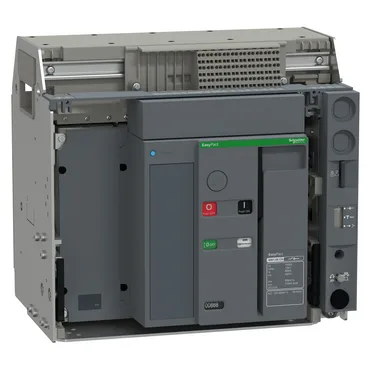
It is built to IEC 60947-3 and carries a suitability-for-isolation mark, meaning it can safely break a circuit and keep it visibly open for lockout/tagout. Its headline rating is 1000 A in utilisation category AC-23A at 440 V AC — that is the motor-switching and mixed-load curve. For a cement plant or heavy panel, this is the number that decides whether the switch holds on a loaded conveyor start or a crusher inrush.
Fault handling and duty cycle
Rated short-time withstand current (Icw) is 50 kA for 1 second at 220–440 V, and the rated short-circuit making capacity (Icm) is 75 kA at the same voltage range. These are the values a site electrical engineer needs for selectivity studies and SCCR coordination downstream of a transformer or generator. Electrical durability in AC-23A is 5000 cycles without maintenance; mechanical durability is 20000 cycles with maintenance, 10000 without.
Drawout mounting on a rail base plate — the switch pulls out for inspection or replacement without disturbing the main bus connections. Connection pitch is 70 mm without a spreader, and connections are rear-located, vertical or horizontal. IP30 protection means it is sealed against tools and wires over 2.5 mm diameter but not against dust ingress. In a cement plant environment, that means it belongs in a clean-ish MCC or panel room, not out on the raw-mill floor. Impulse withstand voltage is 12 kV.