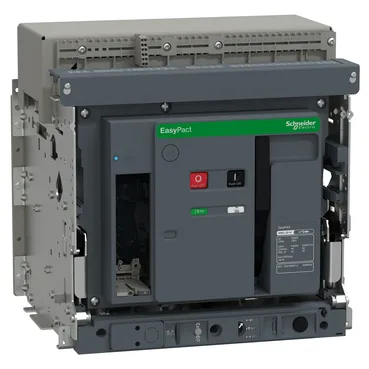
What this 3200 A drawout breaker is for
It's a drawout unit — the breaker chassis stays wired to the bus, and the moving portion pulls out for inspection or swap without killing the main bus. That's the whole point of drawout: you isolate the breaker, rack it out, work on it on the bench, and slide a spare back in. Line-down time measured in minutes, not hours.
Breaking capacity — what the ratings actually mean
The ENW24107 carries a 50 kA Icu (ultimate breaking capacity) at 220…440 V AC, and 42 kA at 690 V AC, both per IEC 60947-2. Icu is the maximum fault the breaker can clear once and still be functional afterward — it's the 'one-shot' rating. For repetitive faults (like a motor starting surge that trips), the Ics (service breaking capacity) is the same 50 kA at 440 V, meaning it can clear that fault level repeatedly without needing replacement. The short-time withstand (Icw) is 50 kA for 1 second at 440 V, which matters for selective coordination downstream — this breaker can sit open while a downstream device clears a lower-level fault, then reclose without damage.
Dimensions: 441 mm wide × 439 mm high × 395 mm deep. That's a big breaker — plan for a dedicated compartment in the switchgear lineup, not a DIN-rail mount. It's IP40 rated (finger-safe, not sealed), so indoor switchboard only. Connection is rear-mounted, vertical or horizontal orientation, with a 115 mm pitch without spreader. The control is push-button only; no motor operator or remote trip included as standard.
Designed and tested to IEC 60947-2 for low-voltage switchgear and controlgear. Rated insulation voltage 1000 V AC, operational voltage 690 V AC, impulse withstand 12 kV. Electrical durability: 5000 cycles at 440 V without maintenance, 2500 cycles at 690 V. Mechanical: 20000 cycles with maintenance, 10000 without. Maximum breaking time 25 ms, closing response 70 ms.