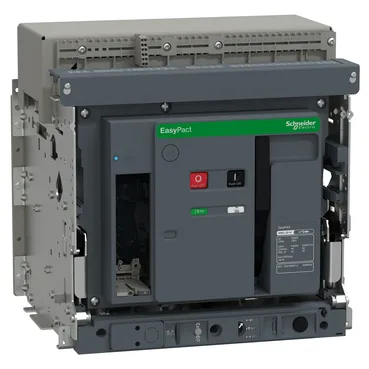
That 3200 A continuous rating means it's sized for the main incoming feeder in a large industrial or utility substation — think a 2 MW transformer secondary at 400 V. The breaking capacity is 66 kA Icu at 220...440 V AC and 50 kA Icu at 690 V AC, both per IEC 60947-2. The Ics (service breaking capacity) matches — 65 kA at 440 V, 50 kA at 690 V — meaning after a fault at those levels the breaker is still usable, not a one-shot device. Category B utilization means it's designed for selective coordination downstream, with a deliberate short-time delay so a feeder breaker trips before this main. Insulation voltage is 1000 V AC, impulse withstand 12 kV — that's the margin for transient overvoltages on a 690 V system. IP40 enclosure protection keeps tools and fingers out but isn't washdown-rated — mount it inside a switchgear cubicle, not outdoors.
Designed and tested to IEC 60947-2 — the international standard for low-voltage circuit breakers. Pollution degree 4 per IEC 60664-1 covers heavy industrial environments. The manufacturer provides a declaration of conformity, IEC test certificates, and a technical manual covering installation, maintenance, and coordination curves. No RoHS or REACH statements are in the evidence, but Schneider typically includes those in the product documentation pack.