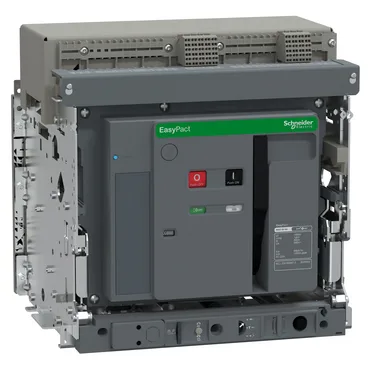
Its headline rating is 1000 A in utilisation category AC-23A at 690 V AC — that means it can make and break motor loads, including occasional inrush, up to that current without maintenance, per IEC 60947-3. For isolation duty, the same standard certifies it as a disconnector: the contact position indicator (visible gap) confirms the circuit is dead when open.
Withstand and making capacity — the fault-handling backbone
Rated short-time withstand current (Icw) is 50 kA for 1 second, or 25 kA for 3 seconds, at ambient temperatures up to 70 °C. That 50 kA / 1 s figure governs selectivity coordination with upstream protection — the switch must hold closed through the clearing time of a downstream breaker. The rated short-circuit making capacity (Icm) is 105 kA AC, which is the peak current the switch can close onto without welding contacts. Impulse withstand voltage (Uimp) is 12 kV, matching the insulation coordination for a 1000 V rated insulation voltage (Ui) system.
Mounting and integration — drawout chassis, rear connection
Drawout mounting on a rail, with rear horizontal or vertical connection at a 115 mm pitch without spreader. The drawout feature means the switch chassis can be racked out for maintenance or replacement without disturbing the main bus connections — a standard requirement for switchgear where uptime matters. IP40 enclosure protection keeps tools and fingers out but is not rated for washdown. Mechanical durability is 20,000 cycles with maintenance or 10,000 without; electrical durability for AC-23A is 6,000 cycles at 440 V and 4,000 at 690 V.