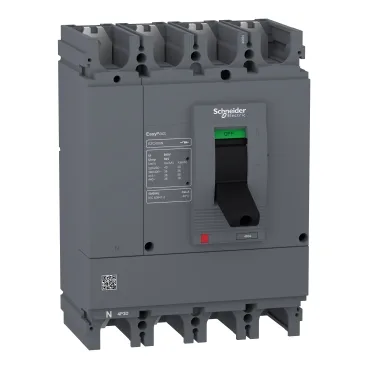
The 36 kA Icu at 440 V AC (IEC 60947-2) is the N-frame breaking capacity — enough for most distribution panels downstream of a transformer, but not for high-fault industrial mains. At 220/230 V it handles 40 kA Icu, so it's comfortable on 208Y/120 V or 240 V services too. The TM-D trip is a fixed thermal-magnetic curve — no interchangeable trip blocks, no electronic adjustment. The magnetic pickup is fixed at 4000 A (10× In), so it's a standard distribution curve, not a motor-protection or selective-coordination curve. For distribution feeders and general branch protection, that's fine. For motor circuits you'd want a Mag-Gard or electronic trip.
Where it goes — panel and deployment context
Fixed-mount, backplate-mounted breaker with front-front connections — line and load both terminate on the front face. The 45 mm pole pitch matches standard EasyPact busbar and accessory spacing. IK07 impact resistance handles incidental tool drops during maintenance. The toggle control and positive contact indication give a clear visual of breaker state — no ambiguity on whether it's tripped or off.
Standards and compliance — what the approvals mean
Listed to IEC 60947-2, EN 60947-2, GB/T 14048.2, and JIS C8201-2-2. The IEC 60947-2 standard covers low-voltage switchgear and controlgear for circuit breakers — it's the global benchmark for MCCB performance, thermal and magnetic calibration, and breaking capacity verification. The GB/T and JIS variants mean it's accepted in Chinese and Japanese markets without additional testing. No earth-leakage protection built in; if you need RCD functionality, you add a Vigicompact module or an external RCCB.