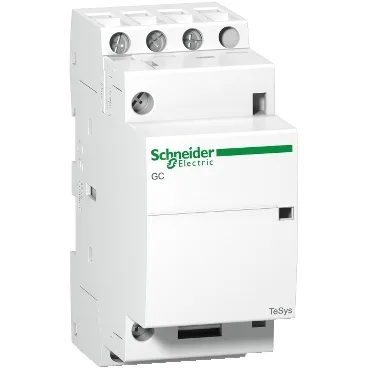
Occupies 2 modules of 18 mm width on the DIN rail — 36 mm total — with a depth of 62.5 mm and height of 85 mm. That's a compact footprint for a 3-pole contactor; leaves room on the rail for an overload relay or auxiliary block. Screw-clamp terminals on both control and power circuits, torqued to 0.8 N·m. Power circuit accepts up to 6 mm² solid or 4 mm² flexible with a ferrule; control circuit takes up to 2.5 mm². The associated fuse recommendation is 25 A gL at ≤ 440 V for the power circuit. IP20 at the terminals (finger-safe per VDE 0106), IP40 inside an enclosure. The protective treatment is TC (tropicalised coating), which handles condensation in non-climate-controlled panels.
The 100,000-cycle electrical durability at AC-7A and AC-7B covers the typical life of a lighting contactor or a small motor starter in a conveyor or pump panel. The 1,000,000-cycle mechanical durability is the contactor's structural limit — you'll wear out the electrical contacts first in most switching duties. Operating time is 10 to 25 ms for opening, 10 to 30 ms for closing. That's fast enough for most control sequences but not a high-speed transfer switch — expect a few cycles of arc on break at rated current. Mechanical robustness: 10 Gn shock when open, 15 Gn when closed; vibration tolerance of 2 Gn open, 3 Gn closed across 5 to 300 Hz. That's enough for panel mounting on a machine frame or a mobile equipment platform. Maximum operating rate is 300 cycles per hour at 50 °C. If your application cycles faster than that — say a rapid-start lighting sequence — you'll need to derate or move to a larger contactor.