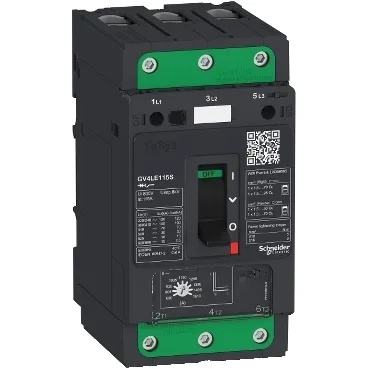
It is rated at 80 A continuous current and carries motor power ratings of 37 kW at 400–415 V AC, 45 kW at 500 V AC, and 55 kW at 660–690 V AC, all at 50/60 Hz. The magnetic electronic trip unit provides adjustable magnetic tripping from 480 to 1120 A, covering inrush and locked-rotor conditions on the connected motor. Breaking capacity reaches 50 kA Icu at 240 V AC, 25 kA at 415 V, and 10 kA at 500 V, certified per IEC 60947-2. The utilisation category is AC-3 per IEC 60947-4-1, meaning it is rated for switching squirrel-cage motors during starting and running — the standard duty for motor circuit breakers in industrial lines. It also qualifies as Category A (no intentional short-time delay) per IEC 60947-2, appropriate for motor branch circuit protection where coordination with downstream contactors is handled separately.
Dimensions are 155 mm high, 81 mm wide, and 116 mm deep, fitting a standard DIN-rail enclosure footprint. The EverLink BTR screw terminals on top accept 1.5–70 mm² solid or 1.5–50 mm² flexible cable; bottom terminals accept 2.5–95 mm² solid or 2.5–70 mm² flexible. Tightening torque is 9 N·m for the larger (16–95 mm²) cable range and 5 N·m for the smaller (1.5–10 mm²) range. IP40 protection suits dry indoor panel environments; IK07 impact rating handles incidental tool contact during commissioning. Climatic withstand conforms to IACS for marine environments, so it can be specified for shipboard auxiliary panels.
If a second-source gate review is required, the TeSys Deca range includes other frame sizes at different current ratings, but the 80 A GV4LE80B is the direct fit for a 37 kW (400 V) motor branch.
The 80 A rated current (In) sets the continuous thermal capacity — this breaker will carry 80 A indefinitely without tripping, per IEC 60947-4-1 continuous duty. The magnetic electronic trip unit responds to short-circuit currents between 480 and 1120 A (6 to 14 times In), covering the typical locked-rotor current of a 37 kW motor while riding through normal starting inrush. For overload protection, the electronic trip provides adjustable time-current curves, though the specific thermal setting range is not listed here; the breaker is designed to coordinate with a downstream TeSys contactor for full motor starter functionality. Electrical durability is 14,000 cycles at AC-3 duty with half rated current (In/2) and 7,000 cycles at full rated current (In) at 440 V. Mechanical durability is 40,000 cycles. These numbers define the maintenance interval: at one start per hour, the electrical contacts last roughly 2–3 years before replacement is prudent. The maximum operating rate of 25 cycles per hour sets a hard limit for jogging or rapid cycling applications. Power dissipation per pole is 6.1 W at rated current, totaling 18.3 W for the three poles. This heat must be considered in enclosure sizing — a sealed panel with multiple breakers may require forced ventilation or derating. The fire resistance rating of 960 °C per IEC 60695-2-11 ensures the enclosure material will not propagate a flame under fault conditions.