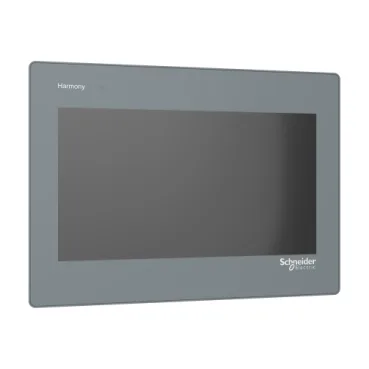
What this HMI brings to the panel
The Schneider Electric HMIET6501 is a 10-inch colour TFT LCD touch panel from the Easy Harmony ET6 series, running on an ARM Cortex-A8 processor with 256 MB device memory and 256 MB user data memory. The resistive single-touch analogue touch panel handles gloved or wet hands on the line, and the 16-million-colour display with 16 brightness levels stays readable across factory floor lighting conditions. Front panel is IP65-rated (IEC 61131-2), so it takes washdown splashes and airborne dust in food, beverage, or light industrial environments; the rear panel carries IP20.
Panel cut-out and mounting
Mounts with four screws into a panel 1.6 to 5 mm thick; the required cut-out is 255 x 185 mm. Overall dimensions are 10.7 in (271 mm) wide, 7.9 in (201 mm) tall, and 1.9 in (47 mm) deep behind the panel.
Communications and protocols
Two serial ports on the bottom: one RS-232C (SUB-D 9-pin male) and one RS-422/485 (SUB-D 9-pin male), both running 2400 to 115200 bps, with the RS-485 port also supporting up to 187500 bps. A USB 2.0 micro-B port on the back handles programming and data transfer. Downloadable protocol support includes Modbus, Uni-TE, and third-party protocols — covers most PLCs you'll find in a retrofit or new line without buying a gateway.
The HMIET6501 carries IEC 61000-6-4 (emission) and IEC 61000-6-2 (immunity) for industrial EMC, plus IEC 61131-2, UL 61010-2-201, and CSA C22.2 No 61010-1-201. It complies with the Low Voltage Directive 2014/35/EU and EMC Directive 2014/30/EU.
Rated for 10 to 90 % non-condensing relative humidity, operating altitude up to 2000 m, and vibration resistance of +/- 3.5 mm at 5-9 Hz and 9.8 m/s² at 9-150 Hz per IEC 61131-2. Shock resistance is 147 m/s² for 11 ms in X, Y, Z directions. Built-in real-time clock operates from 0 to 50 °C and 10 to 90 % RH, with a 5 ms immunity to micro-breaks on the supply.
Software and programming
Programmed with Vijeo Designer Basic (included), supporting up to 200 application pages. Character fonts cover ASCII, European, simplified Chinese, traditional Chinese, Japanese (ANK and Kanji), Katakana, and Korean.