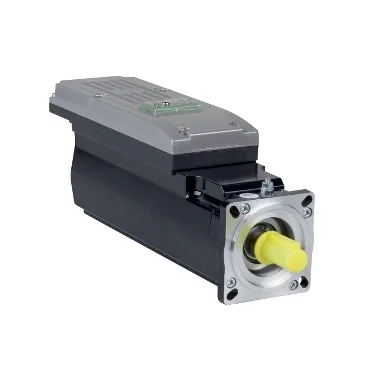
PacDrive 3 ILM in one paragraph
The ILM0701P12F0000: The Schneider Electric PacDrive 3 ILM servo motor integrated drive pairs a 0.5 N.m continuous-rated rotor with an integrated drive stage on a 70 mm flange, with 0.5 N.m nominal torque and a 3.5 N.m peak stall torque to absorb the inertial bursts of a sizing step without saturating the inverter (cites:,). 310 W of nominal output power at a 0.6 A line-rated current keeps the motor inside the natural-convection thermal envelope; forced-air assist is not specified because the housing relies on surface cooling alone (cites:,).
Torque, current, and the headroom for sizing
Continuous stall torque sits at 1.1 N.m against 0.5 N.m nominal at speed — the nominal-rating figure reflects what the rotor delivers in the operating envelope, while the continuous-stall ceiling is the absolute torque limit before thermal foldback (cites:,). Peak stall torque of 3.5 N.m is the short-duration margin the integrated drive can ask for during acceleration transients; sizing the mechanical system against peak rather than nominal avoids nuisance trips on every index move (cites:). Maximum Irms of 5.7 A versus a continuous 1.55 A stall current shows the same pattern: roughly 3.6× peak-to-continuous headroom for transient current demand (cites:,). Nominal speed of 6000 rpm is the published design point; the back-EMF constant of 46 V/krpm at 20 °C means the drive approaches its bus-voltage ceiling near top speed, which matters when the machine spends long stretches at rated rpm (cites:,).
Mechanical fit and shaft loading
The 70 mm flange, 60 mm centering collar with 2.5 mm depth, and four 5.5 mm mounting holes follow the IEC standard-flange pattern, so the motor drops into machine frames designed around the ILM family without adapter plates (cites:,). Overall length of 219 mm and a keyed 11 mm shaft with 23 mm engagement and 18 mm key width determine the pulley, pinion, or coupling selection — the key dimensions match the part drawing exactly (cites:,). Maximum radial force Fr drops from 660 N at 1000 rpm to 360 N at 6000 rpm, so a belt or gear train preloaded close to the low-speed limit will exceed the shaft-bearing envelope as the line ramps to top speed (cites:). Maximum axial Fa is constrained to 0.2 × Fr, the typical rule-of-thumb guard against preload from the driven load stacking axial force on the front bearing (cites:).
Feedback, brake, and what ships in the box
Absolute multiturn SinCos Hiperface feedback means the axis keeps its position reference through power cycles — no homing routine on every restart, which matters on a PacDrive 3 line where cycle-time loss is line-throughput loss (cites:). A holding brake is fitted and rated at 3 N.m holding torque, sized to park the axis in power-loss conditions rather than to brake a moving load — the brake envelope and the continuous-torque envelope are separate design limits (cites:,). Natural-convection cooling means no fan cable and no fan-failure mode; IP54 on the housing keeps the motor safe from dust ingress and water spray from any direction, but does not qualify it for direct washdown duty (cites:,). Six-pole rotor with one motor stack gives the inductance and resistance values that determine the current-loop bandwidth: 10.4 Ω phase-to-phase at 20 °C rises to 7.23 Ω phase-to-neutral at 120 °C, and stator inductance follows the same temperature dependency (cites:,).