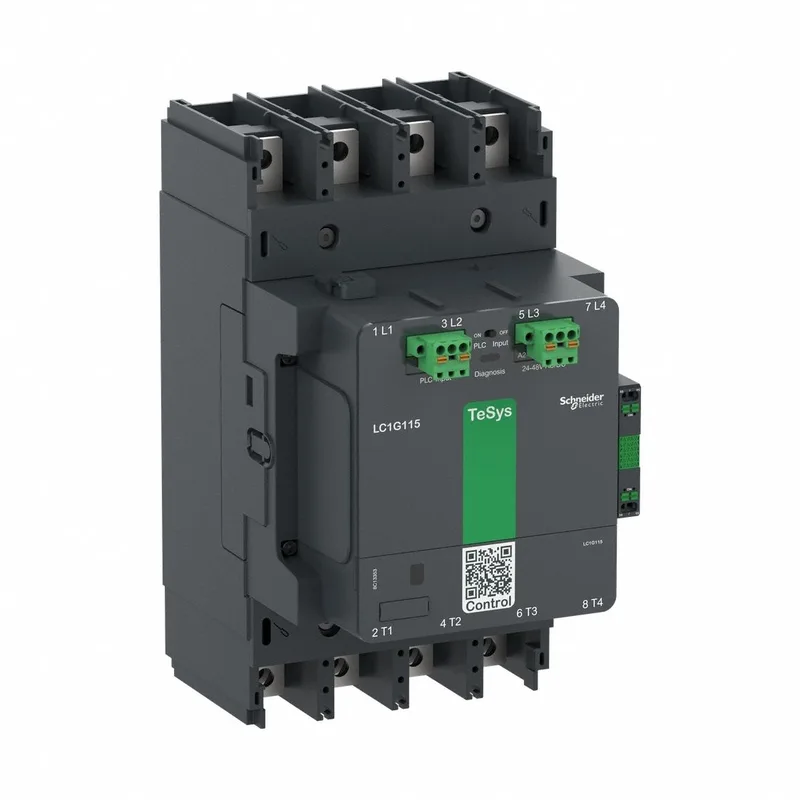
Integration brief – LC1G1504LSEA
4-pole TeSys Giga contactor in the LC1G family, set up for power switching of motor loads up to 150 A in AC-3 duty. Built-in bidirectional peak limiting on the coil suppresses switching transients – no external surge suppressor needed on the control circuit. Rated breaking capacity 1280 A at 440 V and making capacity 1890 A – numbers that confirm the contactor can handle inrush and fault clearing within the panel's protection coordination. Mechanical durability rated to 8 million cycles; for safety-rated applications the B10d is 400,000 cycles at nominal load per EN/ISO 13849-1.
Lifecycle & compliance status
Standards coverage includes EN/IEC 60947-4-1, UL 60947-4-1, CSA C22.2 No 60947-4-1, JIS C8201-4-1, plus UL 60335 household appliance references. That's a single part that satisfies IEC, UL, and CSA panel builds without variant splits.
Mounting & wiring notes
Plate mount only – no DIN rail option. 4-hole pattern with 35 mm connection pitch on the power terminals; busbars sized for 25 x 6 mm cross-section or ring terminals up to 185 mm². Tightening torque on power connections is 18 N.m – tool selection matters for consistent clamping. IP2X with shrouds on the front face, so finger-safe termination if covers are fitted. Operating time: closing 40-70 ms, opening 15-50 ms – falls within typical contactor response for coordinated starter setups. Maximum electrical operating rate 600 cycles/h for AC-3, 300 cycles/h for AC-1.
Sourcing & order recommendation
Active, current-production part. No escalation needed for supply – confirm the BOM line and we can place an order against your RFQ. The 4-pole format with 1 NO + 1 NC auxiliary block built in covers most interlocking and feedback requirements; no auxiliary kit required for basic status. If the panel operates near 40°C ambient, note the rated current table: 150 A AC-3 at <= 440 V, but the AC-1 current is 275 A at <40°C – observe derating if the panel runs hot. The power dissipation per pole is 10 W in AC-1 at 275 A and 5 W in AC-3 at 150 A, so enclosure heat load is predictable.