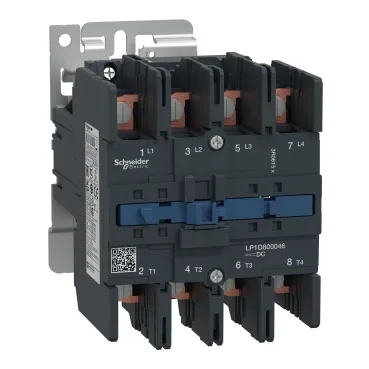
It's designed for switching resistive heating elements, lighting banks, or other non-inductive loads in industrial control panels. The 72 V DC wide-range control coil means it can be driven directly from a 48 V or 72 V DC bus without an extra converter — something to check if your panel runs on a nominal 48 V battery-backed supply. Mounts on a rail or plate, and the IP20 front face keeps accidental contact out while letting it sit inside a standard enclosure.
The AC-1 utilisation category is the key rating here. The continuous thermal current (Ith) is 125 A at 50 Hz — that's the current it can carry continuously through the power circuit. For a resistive heater bank pulling 100 A, this contactor has headroom; for a motor start, you'd want an AC-3 rated unit instead. The 72 V DC coil draws 22 W inrush at 20 °C. That's the peak power to pull the contactor in; holding power is lower. No built-in suppressor module is included, so you'll need to add a flyback diode or RC snubber across the coil if your PLC output can't handle the inductive kickback. The operating time is 6 to 20 ms opening and 20 to 35 ms closing — fast enough for most sequencing, but if you need faster arc extinction on a DC load, factor in the opening delay.
Certified to CSA C22.2 No 14, EN 60947-4-1, EN 60947-5-1, IEC 60947-4-1, IEC 60947-5-1, and UL 60947-4-1. That covers the main North American and IEC standards for contactors and motor starters. Flame retardance is V1 per UL 94, and fire resistance is 850 °C per IEC 60695-2-1 — so it won't propagate a flame if a fault heats it up.