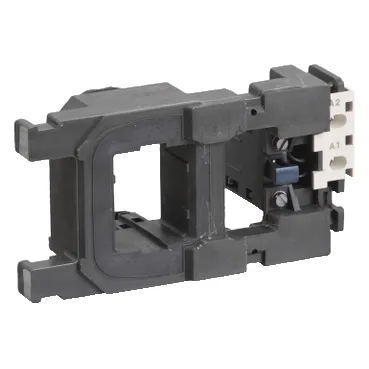
The Schneider Electric LX4FH045 is a replacement contactor coil from the TeSys range, designed to fit FH-series contactors. It operates on a 45 V DC control circuit with a DC wide-range coil technology, meaning it accepts a broader voltage band than a standard fixed-coil design — the operational limits span 0.85 to 1.1 times Uc at 131 °F (55 °C), and dropout occurs between 0.15 and 0.2 Uc at the same temperature. This gives the coil some tolerance for voltage sag on long control-wire runs without nuisance dropout. The coil draws an inrush resistance of 2.81 Ohm at 68 °F (20 °C) and settles to 611.4 Ohm holding at the same temperature. Closing time is 40 to 50 ms; opening takes 40 to 65 ms. The part carries no built-in suppressor module, so if your application requires flyback suppression (common with PLC or solid-state outputs driving the coil), you will need to add an external diode or RC snubber across the coil terminals.
The part belongs to the TeSys range (category 18401-WORLD SERVICE PARTS(CTR ACCESS)), which is Schneider's broad contactor and motor-control family. The LX4FH045 is a service-part coil, not a full contactor — it is intended as a field-replacement component for an existing FH contactor whose coil has failed.
Deployment context and integration notes
This coil mounts onto the FH-series contactor frame, which is a DIN-rail or screw-panel mounted device typical of motor-control centers and industrial control panels. If the panel ambient exceeds 55 °C, the coil's thermal margin narrows and dropout voltage shifts — verify the control voltage stays above 0.85 Uc at the elevated temperature. Because the coil lacks a built-in suppressor, the installer must account for the inductive kickback when de-energizing the coil. A free-wheeling diode across the coil terminals (cathode to positive) is standard practice for DC control circuits driven by a PLC output or relay. Without it, the voltage spike can damage the driving output or cause erratic behavior in nearby electronics. The coil's DC wide-range design helps with voltage tolerance but does not eliminate the need for external suppression.