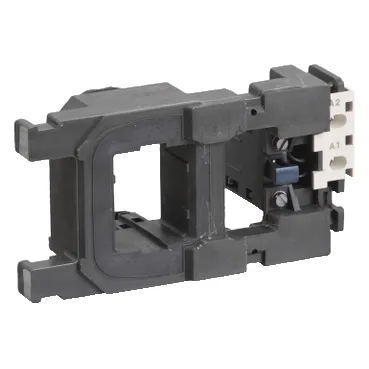
Schneider Electric LX4FH140 — Contactor & Starter Coils

Schneider TeSys LX4FH140 Contactor Coil, 140 V DC, Active

MPNLX4FH140
Active

Schneider Electric TeSys LX4FH140, contactor coil, 140 V DC, DC wide range, without built-in suppressor module, active lifecycle.

StockContact for availability
Lead timeIn Stock wk
MOQ1 pcs
Sourced new & surplus through independent channelsAuthenticity-screened · ESD-safe packingListing updated Jul 2026
How we verify every order →

Specifications

Identification

LX4FH140 — Identification
ParameterValue
Product typeContactor coil
Product rangeTeSys
Device short nameLX4FH
Coil technologyWithout built-in suppressor module

Electrical

LX4FH140 — Electrical
ParameterValue
Control circuit voltage [Uc]140 V DC
Control circuit typeDC wide range
Control circuit voltage limitsOperational 0.85...1.1 Uc 131 °F (55 °C)) Drop-out 0.15...0.2 Uc 131 °F (55 °C))
Coil resistance (avg.)25.84 Ohm inrush 68 °F (20 °C) 5786 Ohm holding 68 °F (20 °C)

Performance & Durability

LX4FH140 — Performance & Durability
ParameterValue
Operating time40...50 ms closing 40...65 ms opening

Environmental

LX4FH140 — Environmental
ParameterValue
Operating temperature23...131 °F (-5...55 °C)

Product details

The LX4FH140 is a replacement contactor coil from the Schneider Electric TeSys range, designed for FH-series contactors. It operates on a 140 V DC control circuit, with a DC wide-range control circuit type. This is a service part — the coil itself, not a complete contactor — meant for field replacement when the original coil fails on a line. The coil's operating time is 40 to 50 ms for closing and 40 to 65 ms for opening. That timing is within the standard range for a DC-operated contactor of this class; the opening time spread reflects the lack of a built-in suppressor module, which allows the magnetic field to collapse at its natural rate.

Control voltage and coil resistance — what to verify before installation

Rated control circuit voltage is 140 V DC, with an operational range of 0.85 to 1.1 Uc at 131 °F (55 °C). That means the coil will pick up reliably between roughly 119 V DC and 154 V DC at the upper end of its ambient temperature range. Drop-out occurs between 0.15 and 0.2 Uc — so the contactor drops out between 21 V DC and 28 V DC, which gives a clean release margin below the pick-up threshold. Average coil resistance is 25.84 ohms during inrush at 68 °F (20 °C), rising to 5786 ohms in the holding state at the same temperature. That ratio — about 224:1 — is typical for a DC economized coil: the inrush current establishes the magnetic circuit, then the holding current drops to a fraction to reduce heat dissipation. The absence of a built-in suppressor module means the installer must add an external flyback diode or varistor across the coil terminals to protect the DC control circuit from the inductive kick when the contactor opens.

Deployment context — panel integration

The ambient air temperature for operation is 23 to 131 °F (-5 to 55 °C), which covers most indoor industrial panel environments. No special washdown or outdoor sealing applies — this is a standard panel component, not an IP-rated field device.

Frequently asked questions

What is the control voltage for this coil?

The control circuit voltage is 140 V DC, with a DC wide-range control type. Operational limits are 0.85 to 1.1 Uc (approx. 119 to 154 V DC) at 131 °F (55 °C).

Does this coil include a built-in suppressor module?

No, the coil is specified without a built-in suppressor module. An external flyback diode or varistor must be added across the coil terminals to suppress the inductive voltage spike when the contactor opens.

What are the operating times for the LX4FH140?

Closing time is 40 to 50 ms; opening time is 40 to 65 ms. The opening time spread is wider because there is no built-in suppressor to control the magnetic field decay.

What is the coil resistance for this part?

Average resistance is 25.84 ohms during inrush and 5786 ohms in the holding state, both measured at 68 °F (20 °C).

MPN
LX4FH140