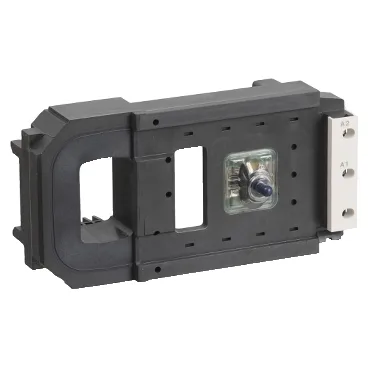
Heat dissipation runs 22.8...27.8 W — that is the continuous power the coil dumps into the panel when held in. In a densely packed TeSys F enclosure, that heat adds up; if you are grouping multiple contactors in a single cabinet, factor the dissipation into the thermal budget rather than relying on the contactor's own ventilation alone. Inrush power is 733 W at 68 °F (20 °C), which is the peak draw during the pickup transient before the coil's inductance rises. That pulse lasts only the 20 ms closing time, but it can sag a 24 V DC supply rail if the power supply is undersized for multiple simultaneous pickups. Hold-in power consumption settles to 48 W at the same temperature — the steady-state draw after the armature seals. That rate translates to one operation every two seconds, which is typical for a high-duty-cycle application like a press control or a fast-indexing conveyor — but at that rate the coil temperature will rise above the ambient, so the 158 °F limit is the coil's own internal temperature, not the cabinet ambient. The control circuit accepts AC 40...400 Hz or DC low-consumption drive. The 40 Hz lower bound means it works on 50 Hz and 60 Hz mains cleanly, and the 400 Hz upper bound covers aircraft or genset supplies. The DC low-consumption label means the coil is wound for a lower steady-state current than a standard DC coil — the 48 W hold-in confirms that — so it is compatible with electronic control outputs that cannot source a high continuous current.
The LX9FL922 is a specific contactor coil — it mounts onto the TeSys F contactor frame, not a DIN-rail base. The coil itself is the replaceable element inside the contactor assembly; swapping it changes the control voltage without replacing the entire contactor.