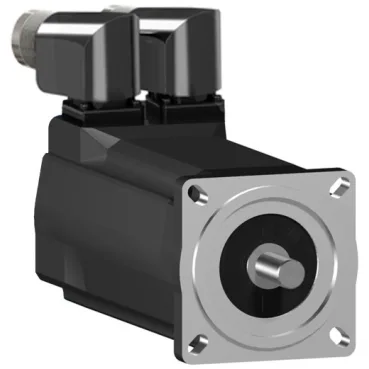
640 W servo motor, 3000 rpm at 400 V three-phase
The SH30702M01A2100 is a Schneider Electric SH3 series servo motor delivering 640 W continuous power. At 400 V three-phase supply it reaches 3000 rpm nominal speed; at 480 V three-phase it runs 3600 rpm. On single-phase 115 V the speed drops to 750 rpm, and on 230 V single-phase to 1500 rpm — the torque also shifts with voltage, from 2.2 Nm at 115 V down to 2.03 Nm at 400/480 V three-phase. This is a three-phase motor designed for servo drive systems. The IP65 rating on both the motor body and shaft bushing (per IEC 60034-5) means it withstands washdown environments — suitable for food processing, packaging, or machine tool coolant exposure.
Absolute Hiperface encoder, smooth shaft, no brake
The absolute single-turn SinCos Hiperface encoder provides position feedback on power-up without a homing sequence — the drive knows the rotor position immediately. This saves cycle time on multi-axis machines and eliminates the need for a reference switch in single-turn applications. The shaft is smooth (no keyway), 11 mm diameter, 23 mm shaft length, with a 4 mm key width slot in the shaft end. The motor flange is 70 mm (2.8 in) with a 60 mm centring collar and 2.5 mm collar depth. Mounting uses four 5.5 mm holes on the international standard flange pattern.
Torque and current characteristics for sizing
Continuous stall torque is 2.04 Nm (18.06 lbf·in) across the 115–480 V three-phase range, drawn at 1.5 A continuous stall current. For acceleration or short overloads, the peak stall torque reaches 7.6 Nm (67.3 lbf·in) — about 3.7× the continuous rating — with a 3-second peak current limit of 6.0 A. The torque constant is 1.36 Nm/A at 120 °C copper temperature. The back EMF constant is 95.9 V/krpm at 20 °C, stator resistance 16.4 Ω, and stator inductance 41.55 mH. These values matter for drive tuning — the high inductance relative to resistance gives a long electrical time constant, which the servo drive's current loop must accommodate. Natural convection cooling means no external fan; the motor relies on its own surface area and the machine's airflow for heat rejection.
Electrical connection options include a straight connector or a rotatable right-angled connector — specify the cable exit orientation at order. Supplied as a single unit.