Speed vs supply voltage — the real constraint
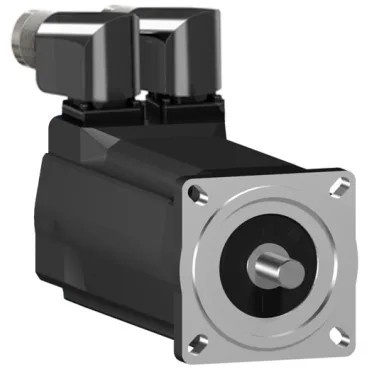
The SH30702M01F2100: This motor's nominal speed depends entirely on the supply voltage you feed it: 750 rpm on 115 V single-phase, 1500 rpm on 230 V single-phase, 3000 rpm on 400 V three-phase, and 3600 rpm on 480 V three-phase. If your line runs 400 V three-phase, the motor delivers 3000 rpm nominal — but the nominal torque also shifts slightly, from 2.2 N.m at 115 V down to 2.03 N.m at 400 V and 480 V. That torque profile matters when sizing for a constant-torque load like a feed axis.
Encoder feedback and brake — what's built in
The feedback device is an absolute single-turn SinCos Hiperface encoder — no homing sequence needed on power-up, which saves cycle time on multi-axis machines. The holding brake is integrated, rated at 3 N.m holding torque, so the vertical axis stays put when the drive is disabled. No external brake resistor or holding circuit to wire.
Continuous and peak torque — the working envelope
Continuous stall torque is 2.04 N.m across the 115-480 V three-phase range, with a continuous stall current of 1.5 A. Peak stall torque reaches 7.6 N.m — roughly 3.7× the continuous figure — which covers acceleration transients and load bumps without tripping the drive's current limit. The continuous power rating is 640 W, with nominal output power varying from 340 W (230 V single-phase) to 780 W (480 V three-phase).
Environmental rating and mounting
IP65 on both the motor body and the shaft bushing per IEC 60034-5 — this motor handles washdown environments in food or packaging lines without a secondary cover. Cooling is natural convection, so no fan or compressed air needed. The flange is a standard 70 mm international pattern with a 60 mm centring collar and 5.5 mm mounting holes.