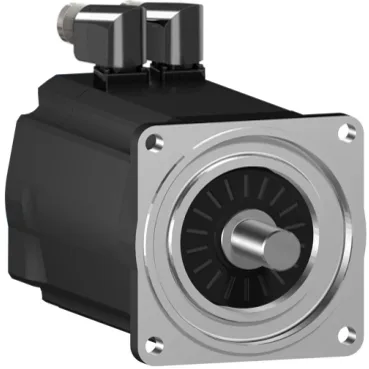
Motor ratings across supply voltages
The SH31003M02A2200 is a three-phase servo motor from the SH3 series, but its performance depends on what voltage you feed it. At 400 V three-phase it delivers 1470 W nominal output power and 7 Nm nominal torque at 2000 rpm; feed it 480 V three-phase and you get 1700 W at 2400 rpm with 6.76 Nm. On single-phase 230 V it drops to 790 W at 1000 rpm, and on 115 V single-phase it's 410 W at 500 rpm. Continuous stall torque is 8 Nm across the 115...480 V three-phase range, with a peak stall torque of 28.3 Nm for transient overloads. Continuous stall current sits at 3.4 A, while the 3-second peak current is 14.7 A — the drive needs to support that peak for acceleration profiles.
Encoder and feedback — absolute multitrack
This motor ships with an absolute multiturn SinCos Hiperface encoder — no homing sequence needed on power-up, the position is retained. The encoder type matters for drive compatibility: not all servo drives support Hiperface protocol, so confirm the drive's feedback interface before pairing. The back EMF constant is 148 V/krpm at 20 °C, and the torque constant is 2.35 Nm/A at 120 °C copper temperature. These numbers let you calculate the required drive DC bus voltage to achieve rated speed and the current loop gain settings.
Mechanical fit and environmental sealing
Flange size is 100 mm (3.9 in) with an international standard flange pattern — mounts to common servo motor brackets without adapter plates. The shaft is 19 mm diameter, 40 mm long, smooth (no keyway), with a 6 mm key width. Centring collar is 95 mm diameter, 3.5 mm deep. IP65 on the motor body and shaft bushing, IP67 on the housing per IEC 60034-5. That means it handles washdown spray and dust ingress — suitable for food processing or wet machining environments. Cooling is by natural convection only, so no external fan or coolant lines needed. This variant has no holding brake (: Without). If your vertical axis or safety circuit requires a brake, you need a different suffix in the SH3 family — the brake adds rotor inertia and changes the mechanical time constant.
Sourcing and lifecycle — active production
Sourced through independent distribution channels. No minimum order quantity published; single-unit and volume quotes handled per request.