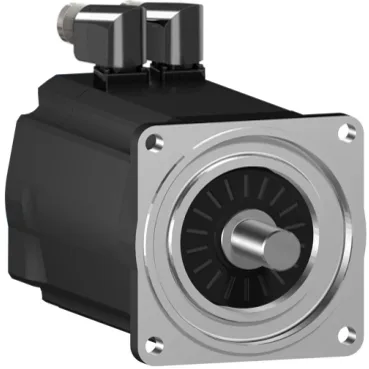
Motor ratings and supply dependency
The SH31003M11A2100 delivers 1500 W continuous power, but the nominal torque and speed depend on the supply voltage: at 400 V three-phase it produces 7 Nm at 2000 rpm, while at 480 V three-phase the torque drops to 6.76 Nm at 2400 rpm. Continuous stall torque is 8 Nm across the 115–480 V three-phase range, with a continuous stall current of 3.4 A — the motor holds that torque at zero speed without overheating, provided the natural convection cooling path is unobstructed. Peak stall torque reaches 28.3 Nm at 14.7 A for 3 seconds — useful for acceleration or overcoming static friction, but the drive must be sized to supply that peak current without tripping.
Encoder, feedback, and connection
The absolute single-turn SinCos Hiperface encoder provides position feedback without a home cycle on power-up — the drive reads the rotor angle directly from the encoder, which matters for applications that must resume position after a power loss. Electrical connection is via a straight connector or a rotatable right-angled connector — the rotatable option helps when cable clearance is tight in the cabinet or along the machine frame.
Mechanical interface and load limits
The motor mounts on an international standard flange with a 100 mm (3.9 in) flange size and a 95 mm centring collar — the four 9.0 mm mounting holes match the standard pattern for this frame size. Shaft is 19 mm diameter with a parallel key, 40 mm shaft length, and 6 mm key width — the IP65 shaft bushing conforms to IEC 60034-5, so the seal holds up in washdown environments provided the mating coupling does not impose axial loads beyond 160 N or radial loads above the speed-dependent limits (1050 N at 1000 rpm, 660 N at 4000 rpm).
Electrical parameters for drive tuning
Stator resistance is 5.3 Ω and stator inductance is 17.4 mH — these set the electrical time constant and influence the current-loop gains in the servo drive; the torque constant is 2.35 Nm/A at 120 °C copper temperature, and the back-EMF constant is 148 V/krpm at 20 °C. The 4-pole design means the electrical frequency at 2000 rpm is 66.7 Hz — the drive's current regulator must handle that bandwidth plus the switching ripple.
Sourced through authorized distribution channels; quantities quoted to order against the BOM.