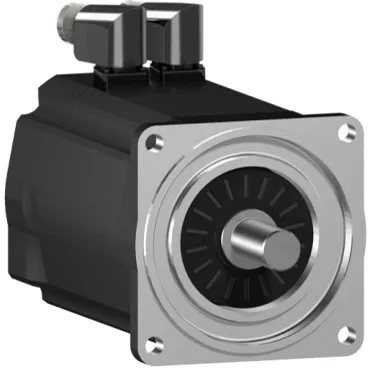
1.5 kW, 100 mm flange, holding brake — SH31003M11F2200 frame reality
The SH31003M11F2200 is a 1.5 kW continuous power servo motor from Schneider Electric's SH3 series, built on a 100 mm flange (IEC standard) with a holding brake rated 9 N.m. The motor delivers nominal torque that depends on the supply: 7.8 N.m at 115 V single-phase, 7.5 N.m at 230 V single-phase, 7 N.m at 400 V three-phase, and 6.76 N.m at 480 V three-phase. Peak stall torque reaches 28.3 N.m across the 115–480 V three-phase range, giving the headroom for acceleration and overload events.
Speed vs supply — the voltage-dependent torque curve
Nominal speed shifts with the input voltage: 500 rpm at 115 V single-phase, 1000 rpm at 230 V single-phase, 2000 rpm at 400 V three-phase, and 2400 rpm at 480 V three-phase. This is a motor designed for multi-voltage global use, but the torque available at each speed point is not the same — nominal torque drops from 7.8 N.m at 115 V to 6.76 N.m at 480 V, so the application's torque demand at the target speed must be checked against the supply voltage the line actually delivers. The continuous stall torque is 8 N.m across the 115–480 V three-phase range, meaning the motor can hold position at zero speed at that torque indefinitely without overheating. The peak stall torque of 28.3 N.m is available for short-duration moves — the drive's current limit (14.7 A RMS for 3 seconds) governs how long the peak can be sustained.
IP65 body, IP67 housing — washdown-ready sealing
The motor body carries IP65 per IEC 60034-5, the shaft bushing is IP65, and the housing is IP67. The rotatable right-angled connector lets the cable exit in one of several orientations, which helps route the cable away from the spray path or into a sealed conduit. Cooling is natural convection — no fan or forced air. This keeps the motor envelope clean but means the thermal capacity is set by the housing surface area and the ambient air movement. The hot copper temperature limit is 130 °C, and the torque constant is specified at 120 °C, so the motor is designed to run hot under continuous load without derating from the nominal torque figures.
Mechanical interface — shaft, flange, and radial load limits
The shaft is 19 mm diameter with a 40 mm length, parallel keyed (6 mm key width). The centring collar is 95 mm diameter with a 3.5 mm depth, and the mounting holes are on a 100 mm bolt circle with 9 mm holes. The flange is the international standard 100 mm pattern, so it mates with standard gearboxes and mounting brackets without custom adaptors.
Electrical parameters for drive tuning
Stator resistance is 5.3 Ohm and stator inductance is 17.4 mH — these set the electrical time constant and influence the current-loop tuning parameters in the drive. The back EMF constant is 148 V/krpm at 20 °C, which means at 2400 rpm the motor generates about 355 V line-to-line — the drive's DC bus voltage must be high enough to overcome this back EMF plus the resistive drop at full current. The torque constant is 2.35 N.m/A at 120 °C, so the 14.7 A peak current corresponds to about 34.5 N.m peak torque — close to the 28.3 N.m peak stall torque spec, confirming the current limit is the binding constraint. The motor has 4 poles, so the electrical frequency at 2400 rpm is 80 Hz.