Motor ratings across supply voltages
The SH31401M01F2000: This SH3 servo motor delivers 1.7 kW continuous power, but the output depends on the supply: 430 W on 115 V single-phase, 860 W on 230 V single-phase, 1670 W on 400 V three-phase, and 1960 W on 480 V three-phase. Nominal torque follows a similar pattern — 11 Nm at 115 V single-phase drops slightly to 10.4 Nm at 480 V three-phase — so the torque budget stays tight across the voltage range. Nominal speed shifts with the supply: 375 rpm at 115 V single-phase, 750 rpm at 230 V single-phase, 1500 rpm at 400 V three-phase, and 1800 rpm at 480 V three-phase.
Brake and torque for vertical-axis loads
The integrated holding brake delivers 23 Nm holding torque — more than double the nominal torque — so it holds a vertical load at standstill without power to the motor windings. Peak stall torque reaches 27 Nm across the 115–480 V three-phase range, giving headroom for acceleration transients beyond the 11.1 Nm continuous stall torque. Continuous stall current is 4 A, while maximum RMS current is 10.8 A — the drive must supply the higher figure for peak torque events.
Encoder feedback and mechanical interface
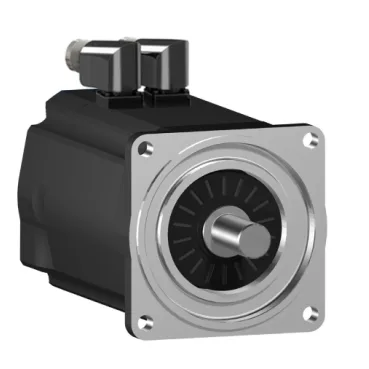
An absolute single-turn SinCos Hiperface encoder provides position feedback without needing a home cycle on power-up — useful for applications where the axis position must be known immediately after a power loss. The motor uses a 140 mm international standard flange, a 24 mm smooth shaft (no keyway), and a 50 mm shaft length — the smooth shaft means the coupling must clamp directly onto the shaft surface.
Environmental sealing and cooling
IP54 at the shaft bushing without the shaft seal ring, IP65 with the seal ring fitted — the motor body and shaft bushing both meet IP65 when the seal is installed, so washdown environments require the seal ring. Cooling is natural convection — no external fan, so the continuous torque rating assumes free airflow around the motor housing; derating applies in confined enclosures. Maximum mechanical speed is 4000 rpm, above which the rotor assembly must not be operated regardless of the electrical speed limit.