Motor ratings that decide the drive match
The SH31401M02A2000 delivers 1700 W continuous power with a nominal torque of 11 N.m at 400 V three-phase supply, and 10.4 N.m at 480 V three-phase. Peak stall torque reaches 27 N.m across the 115...480 V three-phase range, which sets the acceleration ceiling for the load. Nominal speed depends on the supply: 1500 rpm at 400 V three-phase, 1800 rpm at 480 V three-phase, and 375 rpm on 115 V single-phase. Maximum mechanical speed is 4000 rpm, so the motor can overspeed for short moves if the drive supports field weakening.
Encoder and feedback — what the Hiperface signal means for the control loop
The motor ships with an absolute multiturn SinCos Hiperface encoder. This gives position feedback without a home cycle on power-up — the multiturn count tracks absolute shaft position over multiple revolutions, so the controller knows the load position immediately after a power cycle. The SinCos analog track provides high-resolution velocity feedback for the servo loop; the Hiperface protocol carries the absolute position data over a single cable pair. Confirm the drive's feedback card supports Hiperface — most Schneider Lexium drives accept it natively, but third-party controllers may need an interface module.
Mounting and environmental fit
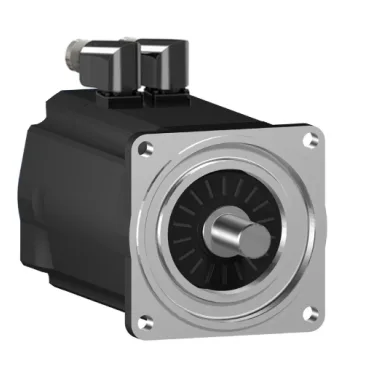
The motor uses an international standard flange with a 140 mm flange size and a 130 mm centring collar. Mounting holes are 11 mm diameter on a 5.5 in (140 mm) bolt circle — standard for this frame class, so it swaps into existing SH3-series mounts without adapter plates. IP65 rating on the motor body and shaft bushing means it handles washdown and dust ingress per IEC 60034-5. The shaft bushing without seal ring is IP54 — if the application sees direct spray on the shaft exit, add an external lip seal or specify the IP65 shaft bushing variant. Smooth shaft, 24 mm diameter, 50 mm shaft length with an 8 mm keyway. No holding brake — the load must hold position through the drive's holding torque or an external brake. Natural convection cooling; no fan, so the torque derating at low speed is minimal but the motor relies on the machine's airflow at higher speeds.
Sourced through independent distribution channels. No stock-holding claim; quoted per RFQ.