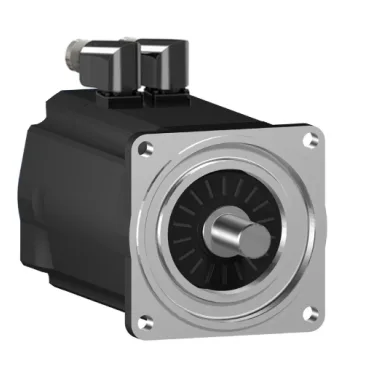
Three-phase supply, voltage-dependent speed — the key fit constraint
The SH31401M12A2200: This is a three-phase servo motor — it will not run on a single-phase supply without a VFD that synthesizes three-phase output. The nominal speed shifts with the line voltage: 1500 rpm at 400 V three-phase, 1800 rpm at 480 V three-phase, and lower speeds on single-phase inputs (375 rpm at 115 V, 750 rpm at 230 V). For a 400 V European line, the working speed is 1500 rpm; for a 480 V North American line, it's 1800 rpm. Confirm your supply voltage before specifying. Torque also follows the voltage: 10.6 Nm at 400 V three-phase, 10.4 Nm at 480 V three-phase, and drops to 11 Nm at 115 V single-phase. The continuous stall torque is 11.1 Nm across the three-phase range, so the motor delivers consistent holding torque regardless of the line voltage within that band.
No holding brake — plan for external braking on vertical axes
Maximum radial force Fr is 1930 N at 1000 rpm, dropping to 1340 N at 3000 rpm. Maximum axial force Fa is 300 N. These limits govern bearing life — overshoot them and the motor bearings fail prematurely, especially on belt-driven loads.
Absolute multiturn Hiperface encoder — no homing sequence needed
The encoder is an absolute multiturn SinCos Hiperface type. On power-up, the drive reads the absolute position directly — no reference run or homing sequence. This saves cycle time on multi-axis machines and eliminates the need for a home sensor. The SinCos interface provides analog sine/cosine signals for high-resolution interpolation; the Hiperface protocol carries the absolute position data over a serial link. The electrical connection is a rotatable right-angled connector. This lets you orient the cable exit in tight cabinets without adding a separate right-angle adapter. The connector is IP65-rated when mated.
IP65 motor, IP67 housing — washdown-ready but shaft seal is the limit
The motor body meets IP65, the housing meets IP67 per IEC 60034-5. That means the motor withstands hose-directed water (IP65) and brief immersion (IP67). The shaft bushing is IP65 — not IP67 — so prolonged submersion at the shaft exit will ingress. For food-and-bev washdown, mount the motor with the connector pointing down and keep the shaft bushing above the water line. Cooling is natural convection — no fan, no forced air. The motor relies on its own surface area and the mounting flange to dissipate heat. Continuous stall current is 4 A; the maximum continuous current Irms is 10.8 A. The thermal limit is set by the copper hot-spot temperature of 130 °C.