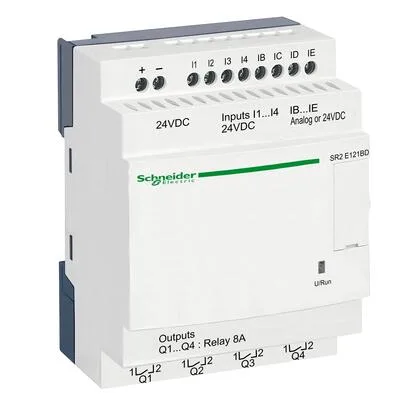
It brings 8 discrete inputs per IEC 61131-2 Type 1 and relay outputs with a mechanical durability of 10 million cycles. A real-time clock is onboard, backed for 10 years at 77 °F (25 °C), and the unit checks program memory on each power-up — a detail that matters for unattended restarts or safety-related logic where memory corruption must be caught early.
Cycle time is 6...90 ms, setting the scan rate for ladder or FBD programs — typical for a smart relay, but if your application needs deterministic response below 10 ms, confirm the worst-case scan against your timing budget. Relay outputs switch at 0.1 Hz under load (Ie) and up to 10 Hz unloaded, with response times of 10 ms ON / 5 ms OFF. Off-state leakage and voltage state 0 guaranteed at 12 V / 10 mA; the current state 1 threshold is ≥ 15 V for the discrete input circuit. These are the numbers you need to match against your load switching profile. Clock drift is specified at 12 min/year over the full 32...131 °F range, or 6 s/month at 77 °F — acceptable for time-stamping and scheduling in most panel applications. Backup time of 10 years at 25 °C means the clock survives extended power-offs without external battery changes.
Compliance and environmental tolerances
Standards coverage includes IEC 61131-2 (Type 1 inputs, Zone B EMC), IEC 61000-6-2/3/4, and individual surge, burst, and radiated immunity tests at Level 3. Operating altitude 2000 m, IP40 front panel / IP20 terminals. These certifications align with the documentation a quality or safety engineer looks for when approving a smart relay for control panels.