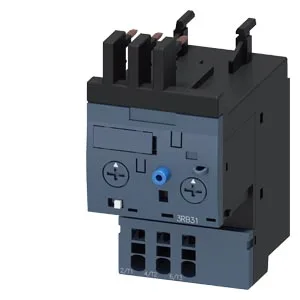
Siemens 3RB3113-4SE0 SIRIUS solid-state overload relay, S00,
Siemens SIRIUS solid-state overload relay, size S00, 12 A thermal current, adjustable trip class 5E/10E/20E/30E, 690 V rated, spring-loaded terminals, contactor mounting.
Specifications
| Parameter | Value |
|---|---|
| Product brand name | SIRIUS |
| Product designation | solid-state overload relay |
| Frame size (overload relay) | S00 |
| Combinable contactor sizes | S00 |
| Reference code (IEC 81346-2) | F |
| Parameter | Value |
|---|---|
| Overload current setting range | 3 ... 12 A |
| Trip class | CLASS 5E, 10E, 20E and 30E adjustable |
| Overload release type | electronic |
| Parameter | Value |
|---|---|
| Rated operational current | 12 A |
| Poles (main circuit) | 3 |
| Rated operating frequency | 50 ... 60 Hz |
| Rated insulation voltage (AC, pollution degree 3) | 690 V |
| Rated value (AC-3e), max. | 690 V |
| Rated surge withstand voltage | 6 kV |
| Main current circuit | spring-loaded terminals |
| Power loss at rated current (hot) | 0.6 W |
| Per pole | 0.2 W |
| Parameter | Value |
|---|---|
| Auxiliary contacts: NO | 1 |
| Auxiliary contacts: NC | 1 |
| Auxiliary contacts: CO (changeover) | 0 |
| Auxiliary switch short-circuit protection (required fuse) | fuse gG: 6 A |
| Switching current at 24 V | 2 A |
| Switching current at 60 V | 0.55 A |
| Switching current at 110 V | 0.3 A |
| Switching current at 120 V | 4 A |
| Switching current at 125 V | 0.3 A |
| Switching current at 220 V | 0.11 A |
| Switching current at 230 V | 3 A |
| Parameter | Value |
|---|---|
| Mounting / fastening method | Contactor mounting |
| Mounting position | any |
| Main-circuit connector arrangement | Top and bottom |
| Auxiliary/control circuit connection type | spring-loaded terminals |
| Removable aux./control terminal | Yes |
| Conductor cross-section: solid | 2x (0.25 ... 1.5 mm²) |
| Conductor cross-section: solid or stranded | 2x (0,25 ... 1,5 mm²) |
| Conductor cross-section: finely stranded with ferrule | 2x (0.25 ... 1.5 mm²) |
| Parameter | Value |
|---|---|
| Operating temperature | -25 ... +60 °C |
| Storage temperature | -40 ... +80 °C |
| Transport temperature | -40 ... +80 °C |
| Relative humidity, operating | 10 ... 95 % |
| Max. installation altitude | 2 000 m |
| Shock resistance | 15g / 11 ms |
| Parameter | Value |
|---|---|
| Width | 45 mm |
| Height | 72 mm |
| Depth | 90 mm |
Product details
Frequently asked questions
Where can I buy 3RB3113-4SE0 and how do I get a price?
This part is sourced and quoted to order against an RFQ through independent distribution. Availability and current pricing are confirmed at quote time — submit an RFQ for a firm price and lead time.
What does the note 'for message tripped' mean on this relay?
The note indicates that the auxiliary contact (97/98) is dedicated to signaling the tripped state — it changes state when the overload relay trips, so you can wire it to a PLC input, alarm light, or remote annunciator.
What is the depth of 3RB3113-4SE0?
The depth is 90 mm. That's the dimension to check against enclosure depth when retrofitting into a tight panel or gland plate layout.
Will 3RB3113-4SE0 drop into a panel specified around 3RT1016-2AP02 without rewiring?
The 3RB3113-4SE0 is designed for contactor mounting and shares the same S00 footprint as the 3RT series contactors. It mounts directly onto the contactor without additional wiring changes for the main circuit, though the auxiliary contact wiring may need to be adapted depending on the existing circuit.
What compliance documentation does Siemens provide for 3RB3113-4SE0?
The evidence lists a substance prohibition date of 10/01/2009, indicating RoHS compliance. Full RoHS, REACH, and UL/IEC documentation is typically available from Siemens for this SIRIUS series relay.
The Siemens 3RB3113-4SE0 is a SIRIUS solid-state overload relay in size S00, rated for a thermal current of 12 A at up to 690 V. Trip class is field-adjustable among CLASS 5E, 10E, 20E, and 30E. That means you can tune the tripping delay to match the motor start profile — fast for pumps, slower for high-inertia loads like fans or centrifuges — without swapping the relay.
Size S00 means it fits the standard contactor footprint for this class. The relay is 45 mm wide, 72 mm high, and 90 mm deep — that 90 mm depth is the dimension you need to check against enclosure depth if you're retrofitting into a tight gland plate or back-panel layout. Spring-loaded terminals accept 2x (0.25 to 1.5 mm²) solid or stranded wire. No ferrule crimp required for the stranded side, but a Pozidriv PZ2 screwdriver (shaft diameter 5 to 6 mm) is needed for the main contact screws. The signaling contact (97/98) has its own shock rating: 9g / 11 ms in the tripped position, versus 15g / 11 ms for the relay body.
The overload relay protects motors by monitoring current. The trip condition is triggered when motor current exceeds the upper current setting value by a factor of 3.5 (maximum) and stays above the lower setting value (minimum). That's the core protection logic — it's not a simple fixed threshold; it follows the motor's actual load curve. Auxiliary contact ratings are given at multiple voltages: 2 A at 24 V, 4 A at 120 V, 3 A at 230 V, and 0.55 A at 60 V, among others. These are the switching capacities for the signaling contact — useful when you're feeding a PLC input or a status lamp. The note "for message 'tripped'" means this contact changes state when the relay trips, so you can wire it to a remote annunciator or HMI. Vibration resistance is 1-6 Hz at 15 mm amplitude, 6-500 Hz at 20 m/s² for 10 cycles — enough for most industrial machinery but not for high-shock applications like stamping presses.