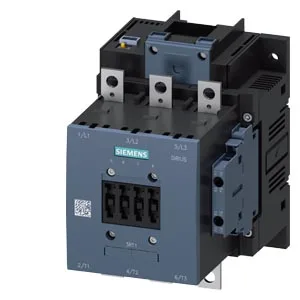
The 3RT1055-6XJ46-0LA2: At 172 mm high, 120 mm wide, and 170 mm deep, this S6 contactor uses screw fixing — not a DIN-rail clip — so factor in the four 9 mm mounting holes when laying out the backplate.
The main power terminals accept solid or stranded wire: two conductors of 0.5–1.5 mm², two of 0.75–2.5 mm², or a maximum of two of 0.75–4 mm². That's standard for this frame size — plan your lugging and ferrule sizes accordingly.
Auxiliary contact ratings — the real selection detail
The auxiliary switch is rated for DC loads, and the numbers drop fast with voltage: 6 A at 24 V, 2 A at 48 V and 60 V, 1 A at 110 V, and 0.9 A at 125 V.
Switching frequency and duty cycles
Maximum switching rates per hour depend on the duty: AC-1 (resistive) at 800, AC-3 (motor start/run) at 750, AC-4 (plugging/inching) at 130, DC-1 at 400, DC-3 and DC-5 at 350. For a conveyor motor running AC-3 duty at 750 ops/hour, that's one cycle every 4.8 seconds — fast enough for most material-handling lines. The AC-4 figure of 130 ops/hour tells you this isn't a reversing starter for high-frequency jogging.
Environmental range
The DC coil's pick-up and drop-out timing is 80–90 ms, with arcing time of 10–15 ms — standard for a contactor this size.