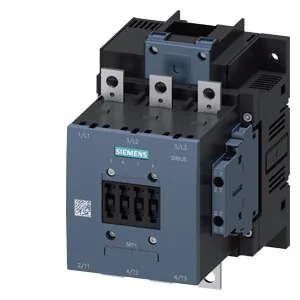
The coil is rated 220-240 V AC and terminates on screw-type terminals, which is the standard for panel builders who prefer field-replaceable terminations over cage-clamp on larger frames. It mounts via screw fixing with a vertical mounting surface that can be rotated ±90° or tilted ±22.5° forward/backward, giving the panel builder flexibility to fit tight enclosures without custom brackets.
Clearances and wiring
The contactor occupies 120 mm width, 172 mm height, and 170 mm depth. That 20 mm forward clearance is the critical dimension for gland-plate planning — if you're stacking contactors in a row, the forward gap governs the door swing. Power circuit wiring accepts stranded cable 25-120 mm². The auxiliary/solid range is 2× (0.5-1.5 mm²), 2× (0.75-2.5 mm²), max 2× (0.75-4 mm²). The 120 mm² stranded capacity means this contactor can handle the main feeder for a moderate motor control center without a separate terminal block.
Duty cycles and endurance
Switching frequency varies by duty: AC-1 (resistive) max 800 operations/hour, AC-3 (motor start/run) max 750 ops/h, AC-4 (plugging/inching) max 130 ops/h. The AC-3e rating also maxes at 750 ops/h. For a conveyor line cycling once per minute, that's well within the 750 ops/h ceiling — no derating needed. Mechanical endurance is 10 million cycles typical, so the contactor outlasts most panel refreshes. Operating delay is 40-60 ms on both AC and DC pick-up. Arcing time is 10-15 ms. These numbers matter for selectivity coordination: the arcing time is short enough that a downstream MCB can clear a fault before the contactor's arc extinguishes, preventing weld risk.
The auxiliary switch is included, rated at 10 A at 24 V, 2 A at 48 V, 2 A at 60 V, and 1 A at 110 V. That covers most PLC input card ranges without an interposing relay.