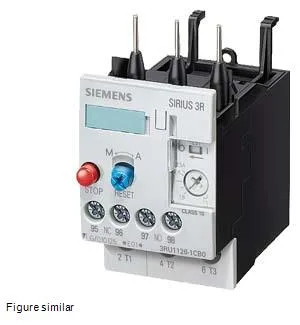
It mounts directly onto a contactor (fastening method: contactor mounting), saving panel space and simplifying the wiring between the relay and the contactor's main circuit.
The Class 10 trip characteristic matches standard general-purpose motors. The S0 frame size (97 mm height, 45 mm width, 96 mm depth) fits the standard S0 contactor footprint from the SIRIUS family — it's a direct mechanical and electrical match for contactors like the 3RT1023 series, so no adapter plates or re-drilling needed. Screw-type terminals on both the main and auxiliary circuits accept solid and finely stranded conductors: 2×(0.5…1.5 mm²) and 2×(0.75…2.5 mm²) per pole, with AWG equivalents of 2×(16…12) and 2×(14…8) for the main contacts, and 2×(20…16) and 2×(18…14) for the auxiliaries. That covers most panel wiring up to 2.5 mm² without needing ferrules, though the finely stranded spec expects core-end processing.
Mounts directly onto a contactor — no DIN rail required, though the contactor itself may be DIN-rail or screw-mounted. Clearance requirements: 0 mm upwards, forwards, backwards, and downwards from the relay body, with 6 mm to the side. That's tight — you can pack these next to each other or against the enclosure wall without derating, as long as ambient stays within the -20 to +70 °C operating range.
Rated for 100 % relative humidity during operation — condensation is fine as long as it's inside the IP20 enclosure. Shock resistance is 8g for 10 ms, which covers most industrial vibration from contactors and motor starters in the same panel. Carries ATEX Type of Protection DMT 98 ATEX G 001 for use in potentially explosive gas atmospheres. Substance prohibition date of 07/01/2006 aligns with RoHS compliance — the relay meets the EU RoHS directive's substance restrictions.
The SIRIUS S0 platform is widely used across European and global panel builds, so stocking depth is generally good. No official successor has been announced — this is the current design.