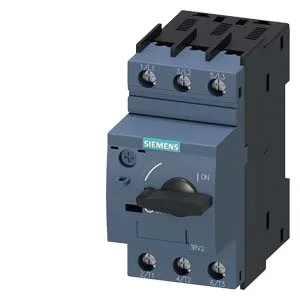
Motor protection circuit breaker, size S00 — Trip Class 10, 100 kA SCCR
The Siemens 3RV2011-0FA10-ZX95 is a SIRIUS motor protection circuit breaker in the compact size S00 frame, designed for direct motor starting and branch-circuit protection. Its Trip Class 10 characteristic means it trips within 10 seconds at 7.2× rated current — standard for general-purpose induction motor starts where the inrush transient clears before the thermal curve locks out. Phase failure detection is built in, so a lost phase on the line side will cause the breaker to open rather than let the motor single-phase to destruction. The interrupting rating is 100 kA at 240 V, 400 V, 500 V, and 690 V AC — that's a single symmetrical rating across the common industrial voltage bands, so no coordination derating is needed when the panel feeds multiple voltage levels. The 100 kA SCCR at 400 V AC means it can safely clear a fault up to that prospective current without cascading to upstream protective devices, which simplifies selective coordination studies for the panel builder. Mounting is screw-and-snap-on onto 35 mm DIN rail per DIN EN 60715; any mounting position is permitted, which helps when fitting into tight enclosure layouts. The screw-type terminals on the main circuit accept 2×(0.75–2.5 mm²) or a single 4 mm² conductor — sized for standard motor branch-circuit wiring up to the S00 frame limit.
Dimensions and panel fit
The 3RV2011-0FA10-ZX95 measures 45 mm wide × 97 mm high × 97 mm deep. The 45 mm width is the standard S00 frame — it occupies one 45 mm module on the DIN rail, matching the footprint of the SIRIUS contactor range it pairs with. Clearance requirements: 50 mm upwards and downwards, 30 mm to the side, 0 mm forwards and backwards. The zero forward clearance means the breaker can be mounted directly against the enclosure back wall or a busbar shield without additional spacing. Operating temperature range is -20 to +60 °C with temperature compensation active across that span. Storage and transport range is -50 to +80 °C. The -20 °C floor matters for unheated enclosures in cold climates — the thermal trip curve stays compensated down to that point.
