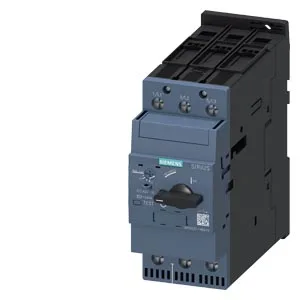
What this breaker does in the nacelle
It's Class 10 trip, which means it will clear a stalled-rotor condition fast enough to protect a standard induction motor winding before the heat soak damages the copper. That 65 kA interrupting rating at 240 V and 30 kA at 400 V tells you it can handle a hard bolted fault on a 480 V distribution bus without the upstream breaker needing to coordinate. The 55 mm width and 149 mm depth fit a standard SIRIUS 3RV2 panel footprint — no surprises on the DIN rail.
Mounting and environment — built for the cabinet, not the bench
Mounting position any, so you can lay this in a vertical or horizontal bus without worrying about the bimetal strip orientation. That -20 °C floor matters if the panel sits in an unheated turbine nacelle or a cold warehouse. The M6 main contact terminals accept 2x 1–35 mm² or 1x 1–50 mm² solid or stranded — screw-type terminals, so you need a torque driver, not a spring-cage tool.
Rated operating voltage 20–690 V. The 15 hp at 230 V, 30 hp at 220/230 V, 60 hp at 460/480 V — these are the NEMA horsepower ratings for the motor it protects. The interrupting ratings at 500 V (5 kA,) and 690 V (2 kA,) drop off because the arc extinction gets harder at higher voltage. At 240 V no external fuse is required; at 400 V the breaker coordinates with a 160 A upstream fuse, at 500 V a 125 A fuse, at 690 V a 100 A fuse. That coordination data saves you the selectivity study time.