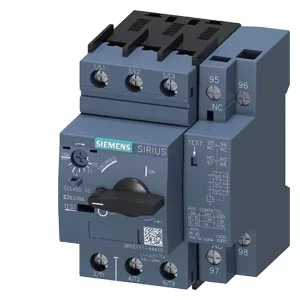
Trip Class 10 means it trips within 10 seconds at 7.2× the thermal setting, matching standard NEMA and IEC motor starting curves — the right fit for general-purpose pump, fan, and conveyor motors that don't need a slower Class 20 or faster Class 5.
Main circuit terminals accept 2× (0.5 to 1.5 mm²) or 2× (0.75 to 2.5 mm²) solid or stranded wire; the M3 screw terminals are the same size as most contactor coils in this class, so the same screwdriver stays in your hand. At 65 mm wide and 97 mm deep, it leaves room alongside a contactor on the same rail — a common pairing in a motor starter stack.
Environmental limits and duty cycle
Maximum switching rate of 15 operations per hour in AC-3 or AC-3e duty — that's one start every four minutes, typical for a motor that cycles on a thermostat or pressure switch, not a rapid-reversing servo.
Listed as current production. This part carries phase-failure detection (trips on loss of one line) but no ground-fault detection — a common distinction in the SIRIUS line that matters for ungrounded delta systems or where GFCI is handled downstream.