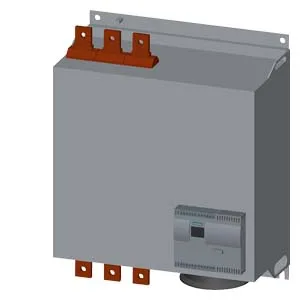
954 A at 40 °C — what that current rating means in the panel
The 3RW4453-6BC36: The integrated bypass contact system switches the thyristors out of the circuit once the motor reaches full speed, eliminating the 1.5–2 V per-device forward drop that would otherwise waste heat continuously. For a 954 A motor, that saves roughly 1.5 kW of dissipation that would otherwise need to be vented from the enclosure.
Inside-delta wiring and adjustable current limitation
This soft starter supports inside-delta circuit configuration, which connects the thyristors in series with each motor winding rather than the supply lines. That reduces the line current the soft starter must carry to 58 % of the motor FLA — so a 954 A unit in inside-delta can control a motor drawing roughly 1645 A line current, effectively extending the range without stepping to a larger frame. Adjustable current limitation lets you set the starting torque profile from 8 % minimum load up to the unit's full rating. The minimum load of 8 % means it can soft-start near-unloaded machines like centrifugal pumps or fans without the current spike that would trip a fixed-torque starter. Motor overload protection and intrinsic device protection are both onboard — the soft starter monitors motor current and its own thyristor temperature, so no separate overload relay is needed in the power circuit. The display for fault signals shows the trip cause directly on the unit.
Mounting is by screw fixing — no DIN rail clip. The unit measures 510 mm wide × 640 mm high × 290 mm deep, so it needs a backplate area roughly the size of a sheet of A3 paper plus clearance. The mounting position allows vertical surface mounting with ±90° rotation and ±22.5° tilt forward/back, which helps fit into existing enclosures with odd panel orientations. Clearance requirements: 100 mm above, 75 mm below, and 5 mm at the sides. The 5 mm side gap is tight — adjacent devices or cable ducts must not block the ventilation slots. Main circuit connections accept busbar or cable from 2/0 to 500 kcmil; control wiring uses screw terminals for 20–14 AWG. Maximum motor cable length is 500 m — beyond that, reflected wave voltages at the motor terminals can exceed the winding insulation rating, especially on 480 V systems. The unit operates at 50 or 60 Hz with a control supply of 115 V at both frequencies.