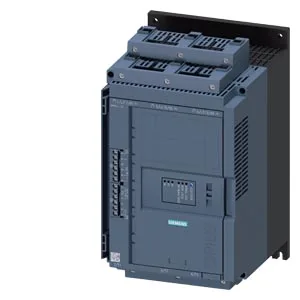
What the trip class and voltage range tell you at startup
The 3RW5114-1XC14-0S: Switch to 20E for high-inertia loads (centrifuges, fans) that need a longer ramp without nuisance tripping. Minimum load is 7.5 A, which is 15 % of the smallest settable Ie — if your motor FLA is below that, the current sensing won't resolve accurately and you'll get nuisance trips or missed overloads.
Fieldbus and HMI — what talks back without a laptop
Onboard PROFIBUS, Modbus RTU, and PROFINET standard — no add-on communication module needed, which saves a slot in the cabinet and one less thing to configure at commissioning. Both the standard HMI and the High Feature HMI are built in; the High Feature version lets you parameterize the analog output (4-20 mA default or 0-10 V) and access the error logbook without a PC. Remote reset is done by cycling the control supply voltage — useful if the starter is in a remote MCC and you don't want to walk back to clear a fault.
Mounting and cooling clearance — the panel layout constraints
Screw fixing to the backplate — 321 mm tall, 185 mm wide, 203 mm deep — so it needs a vertical panel area about the size of an A4 sheet plus clearance. Cooling clearances: 100 mm above, 75 mm below, 10 mm forward, 5 mm at the sides, 0 mm backward — the tightest side clearance means you can butt units side-by-side if you maintain the vertical airflow path. Mounting position allows ±10° rotation and can be tilted forward or backward on a vertical surface — enough to fit under a slanted enclosure roof or on a swing frame.
Temperature derating and vibration — the real-world operating envelope
Operates from -25 to +60 °C during operation, but Siemens flags derating at 40 °C or above — if your panel ambient hits 50 °C, expect to reduce the continuous current rating per the derating curve. Vibration resistance is 15 mm at 6 Hz and 2 g up to 500 Hz; shock resistance is 15 g for 11 ms, dropping to 12 g if contact lifting is a concern — adequate for most industrial floor installations but not for direct engine-mount on a genset.
Starting and stopping control — voltage ramp and soft stop
Starting voltage is adjustable from 30 to 100 %, and the voltage ramp is enabled — tune the initial torque to match the load breakaway without slamming the coupling. Soft torque mode is available for loads that need a gentler initial torque build-up — helpful on belt-driven conveyors to avoid belt slip at start. Ramp-down (soft stop) is built in, with a fixed stopping voltage of 50 % — reduces water hammer on pump systems and prevents load shift on conveyors during deceleration. Inside-delta circuit connection is supported — if your motor is wired in delta, you can connect the starter in the delta legs to reduce the current rating needed.
Control wiring and firmware — what the terminals expect
Control circuit uses screw-type terminals — not push-in, so budget time for a screwdriver on each wire. Firmware updates are supported, which means the unit can be field-upgraded if Siemens releases a patch for communication or logic behavior. Auto-reset is available — if the overload trips on a temporary jam, the starter can re-start automatically once the fault clears, which keeps an unmanned line running.