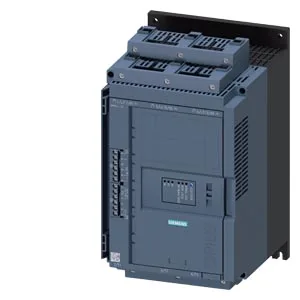
Trip class and motor protection — what the rating means
The 3RW5117-1XC14 is a SIRIUS soft starter rated Trip Class 10A (default), 10E, or 20E per IEC 60947-4-2. Class 10A clears a locked-rotor condition within 10 seconds at 7.5× FLA — the standard choice for standard-start motors driving pumps, fans, and compressors where the load accelerates in under 10 seconds. Minimum settable current is 15.5 A, with a minimum load of 15 % relative to the smallest settable Ie. That means the soft starter can handle lightly loaded motors without nuisance tripping — useful on conveyors or agitators that run well below nameplate.
Voltage range, control supply, and fieldbus
Rated operating voltage is 200–480 V, covering common 208/230/400/460 V three-phase systems. Onboard PROFIBUS, Modbus RTU, and PROFINET standard — no option card required. The analog output is 4–20 mA (default) or 0–10 V, parameterizable via the High Feature HMI. This makes the 3RW5117-1XC14 a single-order-code solution for PLC-controlled lines that need current feedback for load monitoring.
Mounting, clearances, and environmental limits
Dimensions are 321 mm high, 185 mm wide, 203 mm deep — plan for the 100 mm clearance above and 75 mm below for airflow and cable entry. Side clearance is 5 mm; no clearance needed at the rear. IP00 as shipped; IP20 with the optional terminal covers for vertical touch protection from the front. Pollution degree 3 per IEC 60947-4-2, so the soft starter is rated for industrial environments with conductive dust or light moisture.
Soft stop, inside-delta, and firmware update capability
Ramp-down (soft stop) is standard — adjustable from 50 % stopping voltage, which reduces water hammer on pump lines and mechanical shock on conveyors. Voltage ramp start is also standard, with starting voltage adjustable from 30 to 100 %. Inside-delta circuit wiring is supported — this reduces the soft starter current rating to 58 % of the motor FLA, allowing a smaller unit on delta-connected motors. Firmware updates are field-loadable, and the unit logs errors in an onboard logbook for fault tracing.