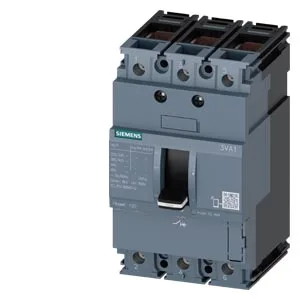
The Siemens SENTRON 3VA1010-2ED36-0CH0 is a 3-pole molded case circuit breaker (MCCB) rated for 100 A continuous current at 40 °C, with a TM210 thermal-magnetic trip unit. It's a line-protection device — meaning it sits between the transformer or bus and the downstream distribution, not on a motor branch.
This MCCB delivers 52.5 kA at 240 V, 32 kA at 415 V, 13.6 kA at 440 V, and 7.5 kA at 690 V. The 52.5 kA figure at 240 V is the headline — it clears a 52.5 kA prospective fault without self-destructing. At 415 V (common in European industrial panels) the 32 kA rating still covers most transformer-fed busways. The drop at 690 V to 7.5 kA means you need to check coordination if the available fault current exceeds that at the higher voltage.
Thermal derating and auxiliary contacts
The 100 A rating holds steady up to 50 °C ambient, then derates to 96 A at 55 °C and 90 A at 70 °C.