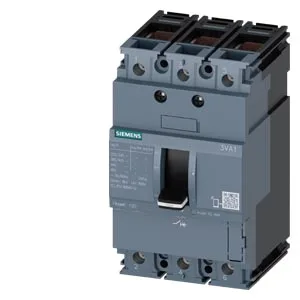
The Siemens 3VA1010-2ED36-0DC0 is a 3-pole SENTRON molded case circuit breaker rated for 100 A continuous current at 40 °C ambient, with a TM210 thermal-magnetic release tuned for line protection — meaning it's the primary feeder breaker in a distribution panel, not a motor-protection device. The TM210 designation tells you the thermal pickup is fixed at 100 A and the magnetic short-circuit pickup is at 10× In (1000 A), which is standard for cable and busbar protection where you need to ride through inrush without nuisance tripping. Breaking capacity is rated at 52.5 kA at 240 V AC, 32 kA at 415 V, 13.6 kA at 440 V, and 7.5 kA at 690 V — the 415 V figure is the one that matters for most European 400 V distribution panels, and 32 kA gives you solid headroom above a typical 25 kA utility fault level. The 690 V rating (7.5 kA) is useful for 600 V class Canadian or mining installations where the breaker sits downstream of a transformer.
Thermal derating — the real-world current you can actually pull
The 100 A rating holds flat from 40 °C up to 50 °C ambient, then begins to taper: 96 A at 55 °C, 94 A at 60 °C, 92 A at 65 °C, and 90 A at 70 °C. If your panel internal ambient runs hot (say 55 °C because of tightly packed breakers), you lose 4 A — not much, but if you're loading the breaker at 98 A continuous, that 96 A derated limit means you're over the curve. The 70 °C figure (90 A) is the maximum operating ambient the breaker is rated for; beyond that you need a larger frame or forced ventilation.
Built-in auxiliary release and contacts — what's wired from the factory
No voltage trigger or shunt trip is built in; if you need remote tripping from a PLC or safety relay, you'd add an external shunt trip accessory. HQ designates high-quantity switching endurance; they're rated for the full mechanical life of the breaker. No communication function, no phase failure detection, no ground fault monitoring, and no other measurement function are built into this base variant — it's a plain thermal-magnetic breaker with UVR and aux contacts. If you need power metering or ground fault, you step up to the 3VA2 series with electronic trip units.
Physical fit — panel space and mounting
The 76.2 mm width is exactly 3 × 25.4 mm — three standard pole pitches on a DIN rail or panel-mount footprint, so it occupies the same space as three single-pole breakers ganged together. Front protection is IP40 — dust-protected but not sealed against water jets. No IP rating on the sides or rear; those rely on the enclosure's own IP rating.
For a main breaker that cycles maybe once a day, that's about 40 years of service. For a breaker in a frequent-switching application (say a welding line that cycles hourly), you'd want a higher-endurance frame or a contactor instead.
Panel fit — what swaps and what doesn't
If you're replacing a 3VA1010-2ED42-0AE0 (which is a 100 A, 3-pole variant with a different trip curve or accessory set), the physical dimensions are identical — same 130 × 76.2 × 70 mm footprint, same mounting hole pattern, same busbar connection spacing. The swap is a straight mechanical drop-in. The electrical difference is in the trip unit and accessories: the -2ED36-0DC0 carries the TM210 release and UVR; the -2ED42-0AE0 may have a different release or no UVR. Check the existing breaker's trip curve against your load before swapping — if the old one had an electronic trip (LSIG), replacing it with a thermal-magnetic TM210 changes the protection coordination.