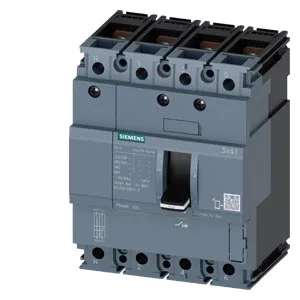
The Siemens 3VA1010-2ED42-0AF0 is a SENTRON molded case circuit breaker (MCCB) in a 4-pole frame, rated for 100 A continuous current (Iu) at 40 °C through 50 °C, with a TM210 thermal-magnetic overcurrent release. It is a line-protection device — no undervoltage release, no ground-fault module, no communication function — built for straightforward branch-circuit overcurrent and short-circuit protection in distribution panels.
This breaker carries a 52.5 kA interrupting rating at 240 V AC and 32 kA at 415 V AC, dropping to 13.6 kA at 440 V and 7.5 kA at 690 V. At 415 V (common in European 400 V systems), the 32 kA rating still gives good headroom for most industrial service-entrance or sub-distribution applications.
Above that, it derates linearly: 96 A at 55 °C, 94 A at 60 °C, 92 A at 65 °C, and 90 A at 70 °C.
Auxiliary contacts and wiring note
The auxiliary switch signals the breaker's ON/OFF position; the trip alarm switch closes only on a fault trip, not on manual opening. This is useful for remote status monitoring or for tripping an upstream contactor on a fault. No undervoltage release or shunt trip is fitted — if you need remote tripping, you will add those as separate accessories.