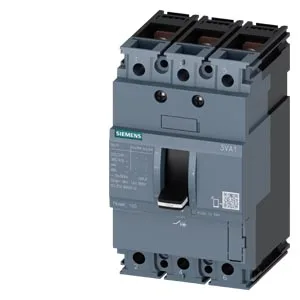
What this breaker does on the line
It's a 3-pole unit rated 100 A continuously at 40 °C, and it holds that same 100 A rating all the way up to 50 °C before it starts to derate (98 A at 55 °C, 96 A at 60 °C, 94 A at 65 °C, 91 A at 70 °C). The interrupting ratings are substantial for a 100 A frame: 121 kA at 240 V AC, 75.6 kA at 415 V, 52.5 kA at 440 V, and 11.9 kA at both 500 V and 690 V. The overcurrent release is a TM210 — thermal-magnetic, fixed at 100 A, likely non-adjustable for the thermal pickup, so the trip curve is set at the factory.
Built-in undervoltage release — what that changes
That's a standard safety feature for applications where you want the breaker to drop out on a power loss — conveyors, machine tools, or any process where an unexpected restart after a brownout is a hazard. The UVR means the breaker won't reclose automatically when power returns; someone has to manually reset it. No ground-fault monitoring module is included, and there's no communication function or voltage-trip add-on — this is a straightforward line-protection MCCB with undervoltage supervision.
It's a DIN-rail mount or direct-panel mount part; the SENTRON 3VA family uses a common footprint, so if you're swapping it into an existing panel that was laid out for a 3VA frame, the bus-bar positions and handle cutout should align.