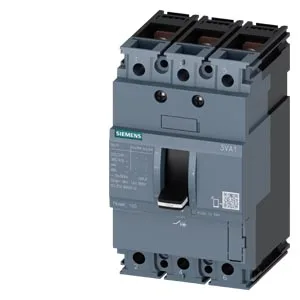
Continuous current rating holds at 100 A from 40 °C up to 50 °C, then derates to 98 A at 55 °C and 91 A at 70 °C — so in a warm enclosure you lose about 9 A off the nameplate by the time ambient hits 70 °C. Breaking capacity is the headline: 121 kA at 240 V AC, 75.6 kA at 415 V, 52.5 kA at 440 V, and 11.9 kA at both 500 V and 690 V.
Overcurrent release and internal architecture
Fitted with a TM210 thermal-magnetic release — the '210' denotes the fixed thermal pickup and magnetic trip threshold. No electronic adjustment, no communication module, no voltage or undervoltage trip. It's a straightforward, field-reliable design: if you need adjustable LSIG or zone-selective interlocking, you step up to the electronic-release variants in the 3VA family. Internally the breaker uses a supplied basic switch (order code 3VA10104ED320AA0) and carries three auxiliary switches HQ as standard — useful for remote status indication without adding a separate aux block. Maximum power loss is 25 W — modest for a 100 A frame, so ventilation in a sealed enclosure isn't a crisis, but don't stack it tight against heat-sensitive components.
Fine for an indoor panel in a conditioned space or a warm factory floor; the storage range covers cold shipping. If the BOM calls for those features, check the 3VA variants with electronic releases or the 3VA1 series with communication modules.