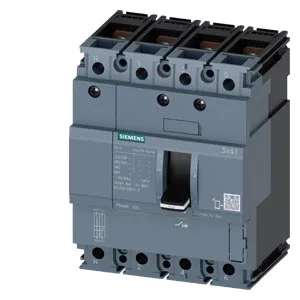
The Siemens SENTRON 3VA1010-4ED42-0CA0 is a 4-pole molded case circuit breaker (MCCB) rated 100 A continuous at 40 °C, with a TM210 thermal-magnetic overcurrent release and an integrated undervoltage release (UVR). It's a line-protection device — not a motor-protective breaker — designed for distribution panels where you need a fixed, non-adjustable trip curve and a UVR to drop the load on voltage loss. The interrupting ratings climb to 121 kA at 240 V AC and stay at 11.9 kA through 690 V, so it handles high-fault service-entrance duty on 480 V or 600 V industrial feeds.
At 240 V this breaker clears 121 kA; at 415 V it's 75.6 kA; at 440 V it drops to 52.5 kA; at 500 V and 690 V it holds at 11.9 kA. Those are symmetrical RMS values — the figures you need for a selective coordination study downstream of a transformer.
At 55 °C it's 98 A; at 60 °C it's 96 A; at 65 °C it's 94 A; at 70 °C it's 91 A. That's a 9 % drop from 40 °C to 70 °C — not steep, but if you're stuffing this into a hot enclosure with other breakers, the 91 A figure at 70 °C is the one to size your load against.
Physical fit — panel and DIN-rail dimensions
If you're swapping from a 3-pole MCCB, check the width budget — this one needs 101.6 mm of horizontal space.
Undervoltage release — what it does and what it needs
It's a factory-installed release, not a field-addon kit. The UVR is wired separately from the main power path; verify the control voltage matches your panel's auxiliary supply before commissioning.