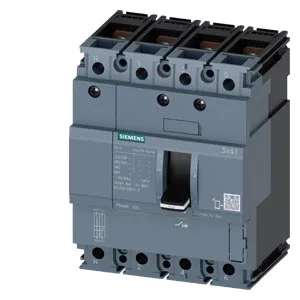
What this MCCB carries — and what it doesn't
The Siemens 3VA1010-4ED42-0CC0 is a SENTRON molded case circuit breaker (MCCB) rated for line protection, not motor protection — no ground-fault monitoring, no communication module, no trip indicator on the front. It's a straight 4-pole 100 A breaker with an undervoltage release (UVR) and two HQ auxiliary switches built in. The breaking capacity varies sharply by system voltage: 121 kA at 240 V, 75.6 kA at 415 V, 52.5 kA at 440 V, and 11.9 kA at both 500 V and 690 V. That 121 kA figure at 240 V is the headline number, but for a 400 V-class panel the 75.6 kA at 415 V is the one that governs the SCCR rating on the line side. Rated current holds at 100 A from 40 °C through 50 °C, then begins a gentle derating curve: 98 A at 55 °C, 96 A at 60 °C, 94 A at 65 °C, 91 A at 70 °C. If the panel ambient runs above 50 °C, the continuous load needs to stay under the derated figure — not the nameplate 100 A. The insulation voltage is rated 800 V, which covers 690 V systems with margin.
Panel fit and wiring constraints
Footprint is 101.6 mm wide by 130 mm tall by 70 mm deep — a standard 4-pole MCCB envelope that drops into a SENTRON distribution panel or a DIN-rail adapter plate. The 70 mm depth is the dimension to watch when the gland plate or door clearance is tight; the breaker projects less than 3 inches from the mounting surface. Power loss at full rated current is 27.5 W, which matters for thermal budgeting inside a sealed enclosure — that's heat that has to be moved through the panel wall or by convection. The undervoltage release (UVR) trips the breaker when control voltage drops below a set threshold — standard for emergency-stop circuits or mains-loss protection schemes. The two HQ auxiliary switches provide status feedback to a PLC or annunciator panel. No communication function on this variant; it's a standalone thermal-magnetic breaker with no Modbus or PROFIBUS interface.