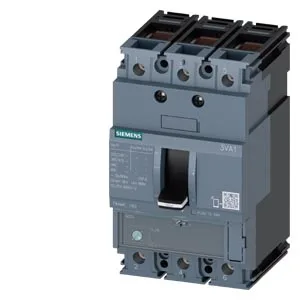
Breaking capacity is the headline spec here: 121 kA at 240 V AC, 75.6 kA at 415 V, and still 52.5 kA at 440 V. At 690 V it still clears 11.9 kA, which covers most industrial motor-drive bus faults. That keeps it simple and reliable for standard distribution duty; you don't need a screwdriver to dial in curves for a motor start, but for a feeder breaker it's exactly what you want.
Above that it derates: 98 A at 55 °C, 96 A at 60 °C, 94 A at 65 °C, and 91 A at 70 °C. The breaker itself is rated for operation up to 70 °C ambient. Maximum power loss is 25 W at rated load. That's the heat it dumps into the enclosure — for a single breaker it's manageable, but in a multi-breaker panel you'll want to check the thermal budget if you're packing several 100 A frames side by side.
Insulation voltage is rated at 800 V, which gives headroom for 690 V systems and covers the common 480/277 V and 400/230 V industrial distributions. The 3VA series is widely used across European and North American panels; UL/CSA listings are standard for the family, though the specific listing should be confirmed at the nameplate.