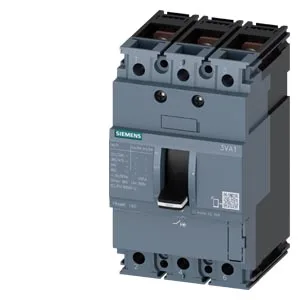
Siemens 3VA1180-4ED32-0KF0 — 80 A SENTRON MCCB for Line Protection
The Siemens 3VA1180-4ED32-0KF0 is a 3-pole molded case circuit breaker from the SENTRON family, designed for line protection in distribution panels. It carries a rated current of 80 A continuous at 40 °C, with a thermal derating curve that holds 80 A through 50 °C, then steps down to 78 A at 55 °C, 77 A at 60 °C, 75 A at 65 °C, and 74 A at 70 °C — so in a warm enclosure the breaker still delivers nearly full rating, but you need to check the ambient at the mounting location if you're loading it near 80 A. Interrupting capacity is the headline number here: 121 kA at 240 V AC, 75.6 kA at 415 V, 52.5 kA at 440 V, and 11.9 kA at both 500 V and 690 V. That 121 kA at 240 V puts it into high-fault applications — think transformer secondaries or large motor control centers where the available fault current is well above typical commercial panel levels. The 11.9 kA at 690 V is the floor; if your system runs at 690 V and fault current exceeds that, this breaker won't clear it safely. Rated insulation voltage is 800 V, so the breaker is rated for use on 690 V systems despite the lower interrupting number at that voltage. The unit ships with an internal shunt trip (STL) release and one auxiliary switch plus one trip alarm switch (HQ configuration) — that means you get remote trip capability and status feedback out of the box without adding external accessories.
Integration — Panel Fit and Accessories
Dimensions are 130 mm height, 76.2 mm width, 70 mm depth — a standard 3-pole MCCB footprint that mounts on a DIN rail or directly to a backplate. The 70 mm depth (2.76 in) is shallow enough for most 200 mm deep enclosures; no special rear clearance needed. Power loss at rated load is 19.2 W maximum, so factor that into enclosure thermal calculations if you're packing multiple breakers in a small cabinet. Operating temperature range is -25 °C to 70 °C; storage range is -40 °C to 80 °C. The breaker includes a trip indicator and a voltage trigger — the trip indicator gives a visual flag after a fault event, which speeds troubleshooting on a panel walk-down.
