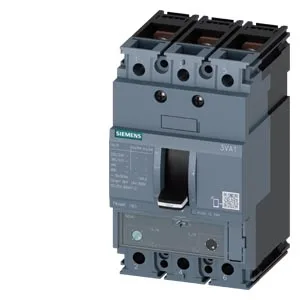
Siemens 3VA1180-4EF32-0AF0 — SENTRON MCCB, 80 A, Line Protection
It's a 3-pole unit with a TM240 thermal-magnetic overcurrent release, carrying 80 A continuously at 40 °C ambient — and it holds that rating through 50 °C, only starting to derate at 55 °C (78 A) down to 74 A at 70 °C. Breaking capacity is the headline number here: 121 kA at 240 V, 75.6 kA at 415 V, 52.5 kA at 440 V, and 11.9 kA at both 500 V and 690 V. That's a high-interrupting rating for a frame this size — it handles fault currents that would weld a standard MCCB's contacts shut.
Fit, Mounting, and Integration
Dimensions are 130 mm tall, 76.2 mm wide, and 70 mm deep — a standard 3-pole MCCB footprint that fits most Siemens and third-party distribution panels. The depth is the critical number for enclosure selection: at 70 mm, it clears shallow wall-mount enclosures without a spacer.
The '240' in TM240 indicates the magnetic pickup is fixed at 240 A (3x the 80 A frame rating). That's a standard ratio for motor branch circuits and general distribution; it avoids nuisance tripping on motor inrush. Power loss is 19.2 W maximum — relevant for thermal calculations in a sealed enclosure. The trip indicator is present, so after a fault event you get a visual flag without needing to test the mechanism.