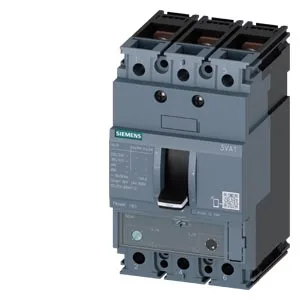
What this MCCB is and what the interrupting ratings mean
The Siemens 3VA1180-4EF32-0AG0 is a SENTRON molded case circuit breaker (MCCB) designed for line protection in distribution panels. It carries three poles and a TM240 thermal-magnetic overcurrent release, meaning the thermal element handles overloads and the magnetic element handles short-circuits — no electronic trip unit to program. The 80 A rating holds continuously at 40 °C ambient; per the datasheet, it derates to 74 A at 70 °C, so the full 80 A is only valid below 50 °C. The interrupting ratings are the key selection parameter. At 240 V it interrupts 121 kA; at 415 V, 75.6 kA; at 440 V, 52.5 kA; at 500 V and 690 V, 11.9 kA. That 121 kA figure at 240 V tells you this breaker is sized for high-fault-capacity panels — typically close to the transformer secondary where available fault current is highest. The 75.6 kA at 415 V covers most European industrial distribution. The drop to 11.9 kA at 500 V and 690 V is a hard constraint: if your system runs at 690 V, verify the available fault current stays under that limit, or you need a current-limiting upstream device.
Physical fit and panel integration
The 3VA1180-4EF32-0AG0 measures 130 mm high, 76.2 mm wide, and 70 mm deep. That 70 mm depth is the dimension that matters for enclosure clearance — it fits standard 200 mm deep distribution boards without the door hitting the breaker handle. The 76.2 mm width (3 inches) is a standard 3-pole MCCB footprint; it occupies three 25.4 mm module positions on a DIN rail or mounting plate. The auxiliary switch configuration is 1 auxiliary switch plus 1 trip alarm switch, factory-fitted, so you get a remote status contact and a separate alarm contact without adding an external module.
Key ratings at a glance
Rated insulation voltage is 800 V, so the breaker is rated for 690 V systems with margin. Maximum power loss is 19.2 W — relevant for thermal calculations in a sealed enclosure. Operating temperature range is -25 °C to 70 °C; storage range is -40 °C to 80 °C. The trip indicator is present, giving a visual flag after a fault trip. No undervoltage release, no ground-fault monitoring, no communication function — this is a plain thermal-magnetic MCCB for straightforward line protection.
