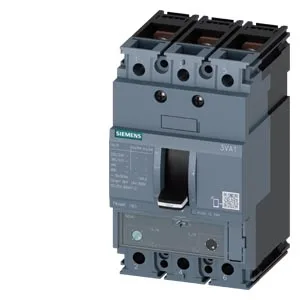
What this MCCB is and what it does
The Siemens 3VA1180-4EF32-0CA0 is a SENTRON molded case circuit breaker (MCCB) designed for line protection in distribution panels. It carries a continuous 80 A at 40 °C ambient through three poles, making it the right size for a feeder or a large motor branch circuit in a 400 V industrial system. The TM240 overcurrent release handles the thermal-magnetic trip curve — thermal for overload, magnetic for short-circuit. That fixed-release design means you're not adjusting trip settings in the field; it's a straight swap-in for a panel spec'd to the TM240 curve. Breaking capacity is the headline: 121 kA at 240 V, 75.6 kA at 415 V, and still 52.5 kA at 440 V. That's enough SCCR headroom for most 480 V downstream panels without needing a current-limiting fuse ahead of it.
Undervoltage release and panel fit
This unit ships with an undervoltage release (UVR) installed — the auxiliary release type is explicitly undervoltage. That means if the control voltage drops below the dropout threshold, the breaker trips. Common in safety circuits where a loss of control power must kill the load. Dimensions are 130 mm high, 76.2 mm wide, 70 mm deep. It's a 3-pole frame in the 3VA1 size class, so it fits the standard mounting footprint for this series — no surprises pulling the old one out and sliding this in.
Thermal derating and real-world current
The 80 A rating holds from 40 °C through 50 °C. At 55 °C it derates to 78 A, at 60 °C to 77 A, and at 70 °C to 74 A. If your panel ambient runs hot — say next to a drive cabinet — plan for the lower figure rather than pushing the 80 A label. Rated insulation voltage is 800 V, so it's comfortable on 690 V systems. The 11.9 kA breaking capacity at 500 V and 690 V confirms it can handle fault clearing at those voltages, though the real-world SCCR will depend on the upstream transformer impedance.
Lifecycle and sourcing
Power loss is 21.7 W maximum at rated load. That's moderate for an 80 A MCCB — the heat stays manageable in a standard IP2X enclosure, but if you're packing a dozen of these in a small panel, add up the dissipation.
