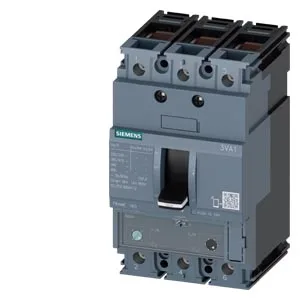
What this MCCB carries
The Siemens 3VA1180-4EF36-0AD0 is a SENTRON molded case circuit breaker (MCCB) rated for 80 A continuous current Iu at 40 °C, with a TM240 thermal-magnetic overcurrent release. That TM240 designation means the thermal pickup is fixed at 80 A and the magnetic short-circuit trip is adjustable — you set the instantaneous trip threshold to match the inrush of your load, typically a motor or transformer feeder. Breaking capacity is the headline here: 121 kA at 240 V, 75.6 kA at 415 V, 52.5 kA at 440 V, and 11.9 kA at 690 V. That 121 kA figure at 240 V means it can safely interrupt a fault current up to that level without rupturing — critical for large transformer secondaries or high-capacity busway taps where the available fault current is high. Three poles, so it switches all three phases. No undervoltage release, no shunt trip, no ground-fault module, no communication function — this is a bare line-protection breaker with three auxiliary switches (HQ type) for status feedback to a PLC or annunciator.
Derating and thermal reality
The 80 A rating holds flat from 40 °C through 50 °C. Above that it steps down: 76.8 A at 55 °C, 75.2 A at 60 °C, 73.6 A at 65 °C, and 72 A at 70 °C. If this breaker lives in a hot panel — say near a drive or inside a NEMA 12 enclosure with solar load — that 72 A at 70 °C is the number to use for your load calculation, not the 80 A nameplate. Operating temperature range is -25 °C to 70 °C; storage range is -40 °C to 80 °C. The storage limit governs handling and warehousing, not running. IP40 on the front means it's protected against tools and wires >1 mm — fine for a clean panel, but not for washdown or outdoor exposure without an enclosure.
Mounting and integration
Dimensions: 130 mm height, 76.2 mm width, 70 mm depth. That 70 mm depth is the can depth behind the panel — check your gland-plate clearance if the breaker is near the back wall of a shallow enclosure. The 76.2 mm width (three-pole) is standard for a 160 A frame SENTRON; it occupies one 3-pole mounting position on the DIN rail or bolted bus. Mechanical endurance is rated at 15,000 cycles. That's the number of on-off operations the mechanism is designed for before wear-out. For a line-protection breaker that sees maybe a few operations a year, that's effectively lifetime. For a breaker used as a disconnect that cycles daily, track it.
