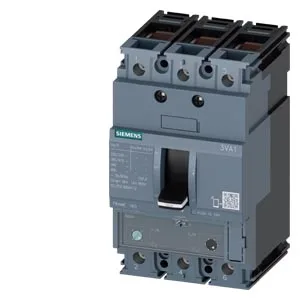
What it is and what the ratings mean for fit
The Siemens SENTRON 3VA1180-4EF36-0CH0 is a 3-pole molded case circuit breaker (MCCB) rated 80 A at 40 °C, designed for line protection in distribution panels. The 121 kA breaking capacity at 240 VAC means it can safely interrupt fault currents up to that level without upstream devices needing to coordinate — critical for high-fault installations like transformer secondaries or large motor control centers. At 415 VAC the interrupting rating is 75.6 kA, and at 690 VAC it holds at 11.9 kA, so the breaker's SCCR (short-circuit current rating) is voltage-dependent; the buyer must match the available fault current at the point of installation. The 80 A rating holds flat from 40 °C through 50 °C (–), then derates to 78 A at 55 °C, 77 A at 60 °C, 75 A at 65 °C, and 74 A at 70 °C (–). For a panel running warm — say 55 °C ambient — the breaker still carries 78 A continuous, so a full 80 A load would need a one-size-up frame. The rated insulation voltage is 800 V, which covers 480/277 V and 600 V systems with headroom.
Panel integration and mounting
The breaker measures 76.2 mm wide, 130 mm tall, and 70 mm deep. That 76.2 mm width is three standard 25.4 mm module spaces on a DIN rail — a 3-pole MCCB occupying exactly three 1-inch slots. The 70 mm depth means it clears most shallow enclosures; verify gland-plate clearance if back-panel wiring is tight. Maximum power loss is 21.7 W, so factor that into enclosure thermal calculations — a sealed stainless box with several breakers may need active venting or derating.
What the auxiliary switch complement means for the controls engineer
The breaker ships with two auxiliary switches and one trip alarm switch. The two aux contacts provide status feedback (open/closed) to a PLC or indicator lamp; the trip alarm switch signals a fault trip separately from a manual open. This is the HQ variant — high-quantity auxiliary switch block — which gives more feedback points than the standard single-aux configuration. The undervoltage release (UVR) will trip the breaker if control voltage drops below a set threshold, which is typical for emergency-stop circuits or undervoltage protection schemes. No communication function is built in; this is a hardwired breaker, not a smart metering unit.
