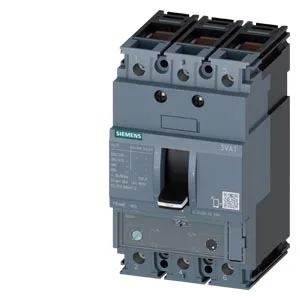
What this MCCB delivers for your feeder protection
The Siemens SENTRON 3VA1180-5EF36-0BH0 is a 3-pole molded case circuit breaker rated 80 A continuous at 40 °C, designed for line protection in distribution panels. Its interrupting capacity of 187 kA at 240 V AC means it can clear a bolted fault at that level without rupturing — critical for high-fault-capacity services where a standard MCCB would fail closed. The 800 V rated insulation voltage gives headroom for 480 V and 600 V class systems. An integrated undervoltage release (UVR) trips the breaker when control voltage drops, so it doubles as a safety disconnect for downstream equipment.
Thermal derating and real-world current
The 80 A rating holds flat from 40 °C through 50 °C. At 55 °C it derates to 78 A, at 60 °C to 77 A, at 65 °C to 75 A, and at 70 °C to 74 A. If your panel ambient runs above 50 °C, size the upstream conductor for the derated value, not the nameplate 80 A. Maximum power loss is 21.7 W — relevant for thermal budgeting inside a sealed enclosure.
Interrupting ratings across voltage levels
The 3VA1180-5EF36-0BH0 delivers 187 kA at 240 V, 121 kA at 415 V, 75.6 kA at 440 V, and 17 kA at both 500 V and 690 V. Selectivity studies should use the voltage-specific value, not the highest number. The 17 kA floor at 690 V still covers most industrial 690 V feeder duty.
Auxiliary and release configuration
Factory-fitted with 2 auxiliary switches plus 1 trip alarm switch (HQ type), and an undervoltage release (UVR). The auxiliary switches report breaker position; the trip alarm signals a fault trip separately from manual open. The UVR provides undervoltage protection — if control voltage falls below dropout threshold, the breaker opens. No ground-fault monitoring or communication function on this variant.
Physical fit and environmental limits
Dimensions: 130 mm height, 76.2 mm width, 70 mm depth. Mounts on a DIN rail or directly to a backplate. Operating temperature range -25 °C to +70 °C; storage from -40 °C to +80 °C. The trip indicator gives a visual flag on fault trip — useful for troubleshooting without opening the panel door.
